
Skip to content
Sign in

Post

The 300 Club

Prez3.4 rating from 122 members21.7K ptsRate

Inability to maintain and/or increase Oil production

In the investing world, specialization is the rule. You don’t see too many people who take a worldwide or multi-disciplinary approach.

Nowhere is this point more clear than when you listen to an energy analyst back to back with a bond analyst.

*****Energy analysts like the well-respected >Pimco’s website:
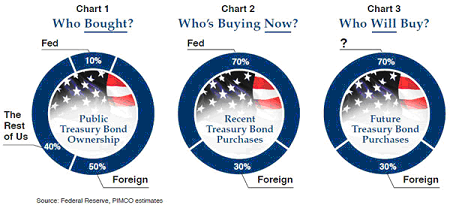
Right-click here to download pictures. To help protect your privacy, Outlook prevented automatic download of this picture from the Internet.

Without the Federal Reserve lending its prodigious printing press to the effort, Treasury yields will necessarily rise. And that’s a terrible situation for our Federal Government and its debt.


*****And while analysts are experts in their field, at the tops of their respective games, neither has discussed the ramifications of the combination of Peak Oil along with massive deficits.

Here’s what we know, right now: the United States produces far less oil than it consumes. So every drop of oil we have to purchase outside of our own production goes somewhere else – outside of our economy. The New York Times recently published a storyhttp://listapp1.bfpnewsletters.com/track?type=click&mailingid=1028100&messageid=523801&databaseid=38800&serial=1211238902&[email protected]&userid=11364&extra=&&&2005&&&http://www.nytimes.com/2011/02/24/business/energy-environment/24oil.htm"> about the disruption in Libya’s oil production that sheds some light on how much GDP we lose to oil price increases:

“As a general rule of thumb, every $10 increase in the price of a barrel of oil reduces the growth of the gross domestic product by half a percentage point within two years.”

At the same time, our official deficit is on track to equal 100% of our $14 trillion GDP any minute now. So every increase in the yields on US Treasuries is a commensurate dip into the GDP.

In 2010, oil averaged about $80 a barrel, and 30-year Treasuries averaged about 4%.

As a thought experiment, let’s assume that oil averages $100 over the next year, and that bond yields spike 1% after the QE2 expires in June.

In this scenario, GDP will effectively shrink 2%. For every $20 increase in the price of oil and every 1% 30 year Treasury increase, we lose 2% of GDP. The United States economy is shrinking at the same time that the Federal Reserve is increasing money supply. More dollars are chasing fewer resources.

Oil prices and loan servicing will hollow out the United States economy like a bloated corpse in a tank full of piranhas, and there is no one in a significant position of power who has the temperament or ability to fix either problem.

Here’s to knowing the inevitable,

Right-click here to download pictures. To help protect your privacy, Outlook prevented automatic download of this picture from the Internet.

Kevin McElroy
Editor
Resource Prospector

Join the conversation about The 300 Club.

Reply

Replies

  1. Looks like Egypt was a litle more important than some thought, and just as corrupt. N o wonder they tried to keep him on.

    Mubarak faces corruption probe on gas to Israel, warrants for Israeli, US partners
    DEBKAfile Exclusive Report March 4, 2011, 1:48 PM (GMT+02:00)

    Hosni Mubarak faces corruption probe

    The prospects of Egypt resuming its gas supplies to Israel dropped to zero Thursday, March 3 when Egypt's state security prosecutor Abdel Magid Mahmud announced that deposed president Hosni Mubarak would be summoned for questioning next week about allegedly corrupt deals for selling Israel Egyptian gas at knock-down prices, debkafile's Cairo sources report. Mahmud claimed he had documentary evidence that Egypt lost more than half a billion dollars on its gas sales to Israel and sought to follow up suspicions that the difference was shared out between the Mubarak family and the Israeli and American partners in the transaction.
    The flow of gas to Israel was suspended on Feb. 5 when Hamas blew up the pipeline running through Sinai during the Egyptian uprising. Our sources confirm that supplies will not be renewed until the end of the corruption inquiry which could go on for years.

    In response to a statement by the Merhav company, the Israeli partners of the joint company EMG, that supplies would be resumed Friday, March 4, word came from Cairo that there is no such intention (as debkafile predicted immediately after the explosion.)
    The damage to Israel's power supply is substantial. Egyptian gas fueled 40 percent of Israel's electricity requirements. In the meantime, world fuel prices have shot up and Israel has been forced to convert its power stations from gas to heavy fuel, incurring extra outlay running into hundreds of millions of dollars a month.
    The new military rulers of Egypt, headed by Defense Minister Field Marshal Mohammed Tantawi, appear helpless to halt the corruption probe against the former president and his family.

    It had been hoped in Washington and Jerusalem that, in the meantime, the generals would at least get the pipeline repaired and the gas flowing again to Israel, in accordance with Cairo's international contract obligations. But the army chiefs refrained from doing so, just as they allowed Prosecutor Mahmud to place the Israel gas deal at the top of the corruption file against Mubarak.

    The prosecutor evidently intends to press ahead with the investigation and release findings scandalous enough to throw Egypt's relations with the United States and Israel into deep crisis.

    Whereas the Americans involved in the gas deal were private businessmen, the Israelis were government officials from the infrastructure ministry in the governments headed by Ariel Sharon and Ehud Olmert.
    The Egyptian prosecutor is already seeking to question Hussein Salem, 83, a close friend of Mubarak and one of the richest men in the country who escaped to Dubai at the start of the uprising; also Yossie Maimon, head of Merhav Sam Zell, the American financier who invested in EMG by buying out some of Hussein Salam's shares in 2007.
    For now, debkafile's Cairo sources add, the military junta has no intention of interfering in the prosecutor's case or plans to summon to Cairo for questioning the Israel and American representatives of the firm. If they refuse to come, he is considering issuing international arrest warrants through Interpol, thereby curtailing their travel plans.

    The military junta, by permitting the prosecutor to inflate the gas deal with Israel to scandalous proportions, has darkened the hopes entertained in Jerusalem until now that the new rulers will provide Egypt and its relations with stability and show an interest in preserving the thirty-year old peace treaty with Israel.
    But now, the generals demonstrating that if peace relations with Israel do not serve their ends, they are have no compunctions about sacrificing their peace partner's interests in order to pander to Egyptian public opinion - even at a loss of the desperately needed $2 billion a year which the gas deal brought the Egyptian treasury.

    1. A very interesting and timely report

      I have to disagree with their conclusion though:

      The military junta, by permitting the prosecutor to inflate the gas deal with Israel to scandalous proportions, has darkened the hopes entertained in Jerusalem until now that the new rulers will provide Egypt and its relations with stability and show an interest in preserving the thirty-year old peace treaty with Israel.
      But now, the generals demonstrating that if peace relations with Israel do not serve their ends, they are have no compunctions about sacrificing their peace partner's interests in order to pander to Egyptian public opinion - even at a loss of the desperately needed $2 billion a year which the gas deal brought the Egyptian treasury.

      This is editorializing at it's worst - the sort of thing I've come to expect from DEBKA.

      This is not about the peace treaty, it's about exposing the corruption of the former regime. It's also about giving the Israeli opposition something solid with which to fight corruption in Israel itself.

      The hidden ground of the Arab uprising is reconciliation with Israel. Political change in Israel will follow once it becomes clear that these emergent democracies can't be bought off or intimidated, and that genuine diplomacy will have to take place.

      Israel too is a young country. I'm betting the youth of Israel identify more with the youth of Egypt than with their own entrenched leadership. Conditions are better now than ever for real progress in that part of the world.

      I don't expect the pipeline will be down for long. There are legal avenues in both Egypt and Israel to address the issue. Meanwhile, a show of good faith is more important right now than punishing a former enemy to no good effect.

      ebear