Fake Bars
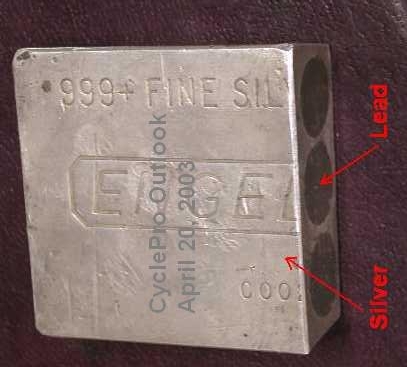
Just something to consider when purchasing physical silver and gold despite it being a potential scare tactic away from physical...
Regards - VHF
-
All my dealers are afraid of fake precious metals ...
MarketCycles
January 10, 2011
 |
.
Recently, when I again loaded up on physical - ALL of my PM dealers (3) told me - in general NOT to buy bars and stick to coins. Just for security reasons.
Some of them even refuse to take bars - or only after having sent the items for inspection ...
They are all especially afraid of fake bars - in Gold as well as in Silver.
Fake coins in quantity are much more difficult to produce - and it is much easier to recognize the fake coins.
Rilled coins are safer than not rilled coins.
To buy over the internet - where you can't touch or test the bars or coins - is less safe than buying the stuff at a coin dealer.
Google for fake gold coins or fake gold bars or fake silver bars or fake silver coins ... it is worth the time, as you will learn the difference between fake or not fake. And still some counterfeits are already of such high quality that even experts fail to recognize the counterfeit.
Check the weight. Different coins have different approximate weights that may vary by very small amounts. For instance, according to "Silver Coin," a 1796 Draped Bust dollar typically weighs about 27 grams. If you found a coin that weighed a great deal more or less, you could safely assume it is a fake.

Look at the edges. Some coins are minted with smooth edges; others have a border known as reeding. Reeding appears as a border of lines at regular intravals around the coin, forming a series of bars. If the coin you are buying has reeding when it should not or does not when it should, it is a fake.
Compare the lettering and numbering. Often fake coins have letters or number that are larger, smaller or in a different style than the authentic coin.
Examine the images on the coin. Counterfeiters often come close to replicating the images on the original coins but get some of the details wrong. Look at details such as the hairstyle or clothing of the figure on the coin.
Examine the small details of the coin. Usually coins have small decorations around the pictures. For instance, the 1796 Draped Bust dollar has stars around the bust on the head side. The original of that coin has eight stars on the left of the bust and seven on the right. A different amount of stars means it is fake.
Compare the price of the coin with current market value. If someone is offering you a silver coin for $175 that normally sells for $200, be suspicious. Using good common sense is your best weapon against acquiring a fake coin.
Join the conversation about Golden Minerals Company.
Reply