

Issued on behalf of HPQ Silicon Inc. Disclosure
HPQ Secures US$625,000 Conditional Purchase Reservation for 500 Additional ENDURA+ MiniMax Power Systems, Bringing Total Potential Sales to US$750,000
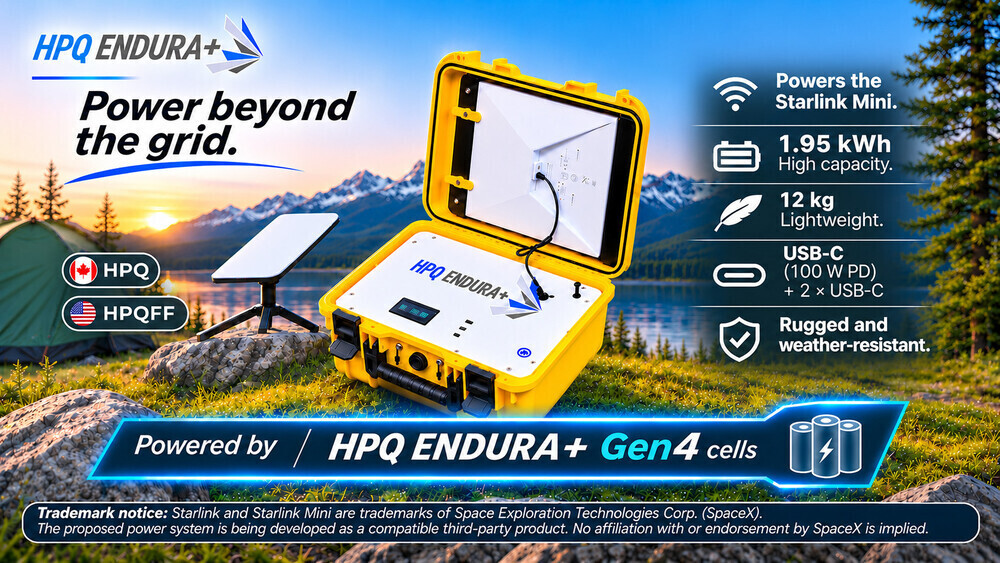
HPQ Silicon Inc. (TSXV: HPQ, OTCQB: HPQFF) has secured a second conditional purchase reservation agreement for 500 HPQ ENDURA+ MiniMax portable power systems, representing US$625,000 (approximately C$890,000) in potential sales. Combined with the company's first conditional purchase reservation for 100 units announced on November 23, 2026, HPQ has now reached 600 units and US$750,000 (approximately C$1 million) in potential sales within nine days of the product's unveiling. The MiniMax is a high-capacity 1.95 kWh portable power system integrating HPQ ENDURA+ Gen4 battery cells designed to provide extended off-grid power for the Starlink Mini satellite internet terminal.
AGORACOM Feature Article Issued On Behalf of HPQ Silicon Inc.
November 26, 2026
Background / Context
HPQ Silicon Inc. is a Quebec-based advanced materials technology company operating across four main business pillars: high-purity silicon production, fumed silica manufacturing, green hydrogen development, and silicon-based anode materials for lithium-ion batteries. This announcement sits within HPQ's Silicon Anode Materials pillar and represents accelerating commercial validation for the company's newly launched ENDURA+ MiniMax product.
The HPQ ENDURA+ MiniMax addresses a practical gap for users who need satellite connectivity in remote environments without conventional electrical infrastructure. Starlink Mini is SpaceX's compact satellite internet terminal designed for portable use in outdoor activities, mobile operations, and emergency response scenarios. While the terminal offers high-speed connectivity in remote locations, it does not include an integrated battery and requires an external power source. With an average power consumption of 25 to 40 watts, maintaining connectivity for extended periods away from the electrical grid presents a challenge for field operations, remote work sites, and off-grid activities.
The MiniMax was unveiled on November 17, 2026, as HPQ's first consumer-facing product built around its Gen4 battery technology. The system incorporates 84 HPQ ENDURA+ Gen4 lithium-ion cells — each rated at 6,500 milliampere-hours (mAh), a measure of total charge capacity — providing nearly 2 kWh of energy storage with extended operating autonomy. The system weighs approximately 12 kg and features a rugged, weather-resistant case with space to store and transport the Starlink Mini terminal alongside the battery pack.
Just six days after the product unveiling, HPQ announced its first conditional purchase reservation for 100 units representing US$125,000. The current announcement demonstrates continued commercial momentum with a significantly larger reservation from a second independent prospective customer.
Details of the Announcement
Second Conditional Purchase Reservation: 500 Units
The second conditional purchase reservation agreement covers 500 HPQ ENDURA+ MiniMax units, representing a potential purchase value of US$625,000 (approximately C$890,000). At US$1,250 per unit, the pricing is consistent with the company's first reservation agreement and reflects the system's positioning as a specialized portable power solution combining high-capacity energy storage with application-specific design for Starlink Mini users.
A conditional purchase reservation agreement is a preliminary commercial commitment that establishes purchase intent subject to specified conditions being met. According to the press release, the purchase reservation remains conditional upon the product meeting agreed technical specifications and applicable certification requirements before it can be converted into a purchase commitment.
This structure protects both parties during the final stages of product development and certification:
For the customer: Conditional status ensures they are not obligated to complete the purchase if the product does not meet specifications or obtain required certifications. This reduces risk while allowing them to secure early access to supply.
For HPQ: The reservation demonstrates serious commercial interest from a second independent customer and provides visibility into potential near-term demand, supporting production planning and capital allocation decisions.
Sixfold Increase in Nine Days
The strategic significance of this announcement extends beyond the absolute dollar value. Within nine days of unveiling the ENDURA+ MiniMax, HPQ has secured conditional purchase reservations from two separate prospective customers totaling:
- 600 units (100 from the first customer + 500 from the second customer)
- US$750,000 in potential sales (approximately C$1 million)
This represents a sixfold increase from the initial 100-unit reservation to 600 total units. According to Bernard Tourillon, President and CEO of HPQ Silicon, "Securing US$750,000 (approximately C$1 million) in potential sales through conditional purchase reservations from two separate prospective customers within nine days of unveiling the MiniMax provides an encouraging early indication of the product's commercial potential."
The rapid accumulation of reservations suggests strong market interest and validates HPQ's product-market fit assessment. For a development-stage technology company transitioning from battery component development to finished product commercialization, early commercial validation reduces execution risk and supports investment in manufacturing scale-up.
Product Specifications and Performance
The HPQ ENDURA+ MiniMax represents HPQ's first consumer-facing product built around its Gen4 battery technology. The system specifications include:
Energy and Power:
- Energy capacity: 1.95 kWh (nearly 2,000 watt-hours)
- Battery configuration: 84 Gen4 lithium-ion cells (6,500 mAh / 23.4 Wh each)
- Extended operating autonomy for Starlink Mini operation
- Power output: 100 W USB-C power delivery port plus two additional USB-C connections
Physical Characteristics:
- Weight: Approximately 12 kg
- Design: Rugged, weather-resistant case with integrated storage for Starlink Mini terminal
- Portability: Single integrated package for battery pack and terminal transport
The power output configuration provides flexibility beyond Starlink Mini operation. The 100 W USB-C power delivery port can charge laptops, tablets, and other devices requiring higher power, while the two additional USB-C ports support smartphones, cameras, and smaller electronics. This multi-device capability extends the system's utility beyond satellite connectivity to serve as a general-purpose portable power station for remote operations.
The rugged case design addresses a practical logistics challenge: transporting both a satellite terminal and its power supply to remote locations. By integrating battery pack and terminal storage in a single weather-resistant package, the system simplifies packing, transportation, and deployment for users operating in challenging environments.
ENDURA+ Strategy: Technology to Commercial Products
According to Bernard Tourillon, the conditional purchase reservations "reflect a central objective of our ENDURA+ strategy: to transform our battery technology into commercial products that address identifiable market needs and create opportunities for revenue generation."
This statement articulates HPQ's strategic evolution over the past two years. The company has invested significantly in developing silicon-based anode materials through its partnership with Novacium SAS, a France-based R&D and engineering partner in which HPQ holds a 36.8% equity stake. This development work has produced successive generations of battery technology — GEN1, GEN2, GEN3, and most recently GEN4 — with each generation demonstrating improved performance over conventional graphite-based lithium-ion cells.
However, technology development alone does not generate revenue. The transition from advanced materials to commercial products requires identifying applications, designing finished products, obtaining certifications, establishing manufacturing capabilities, and building sales channels. The ENDURA+ strategy represents HPQ's framework for converting battery technology development into revenue-generating commercial products.
The MiniMax serves as the first tangible expression of this strategy: a finished product that integrates Gen4 battery technology into a solution designed for an identifiable market need (extended off-grid power for Starlink Mini users) and priced at a level that creates revenue opportunities (US$1,250 per unit).
Gen4 Cell Technology Foundation
The MiniMax is powered by HPQ ENDURA+ Gen4 cells incorporating Novacium's fourth-generation silicon-based anode materials. Silicon-based anodes can store significantly more energy than conventional graphite anodes used in standard lithium-ion cells, offering higher energy density — a measure of how much energy a battery can store relative to its weight or volume.
Energy density is the critical performance parameter that makes the MiniMax commercially viable. By packing nearly 2 kWh of energy storage into a 12 kg portable package, the system delivers extended operating autonomy for Starlink Mini operation — an autonomy level that would be difficult or impossible to achieve using conventional graphite-based cells in a comparably sized and weighted package.
HPQ has previously disclosed strong performance results for Gen4 cells:
- July 2026: Gen4 platform achieved UL 1642 safety certification at 6,500 mAh from an accredited independent laboratory, confirming compliance with one of the industry's most widely recognized U.S. safety standards
- December 2025: Gen4 cells achieved UN 38.3 transportation certification, enabling international shipment
- April 2026: Gen4 21700 cells achieved average capacities exceeding 6,600 mAh under standard testing conditions, with a record cell reaching 6,696 mAh
- April 2026: Under extended deep-discharge testing, Gen4 cells surpassed 7,000 mAh while demonstrating less than 2% capacity degradation over 70 cycles
These certifications and performance metrics demonstrate that Gen4 technology has progressed beyond laboratory validation to meet the safety and regulatory requirements necessary for commercial products. The MiniMax represents the first consumer application of this technology platform in North America under HPQ's exclusive commercialization rights.
Strategic Significance
Two Separate Customers: Diversification and Risk Reduction
The strategic importance of securing reservations from two separate prospective customers cannot be overstated. Single-customer concentration introduces commercial risk — if that customer's circumstances change or if the evaluation does not proceed favorably, the entire revenue opportunity disappears.
By securing reservations from two independent customers totaling 600 units, HPQ has demonstrated that market interest extends beyond a single buyer. This diversification reduces commercialization risk and provides multiple pathways to convert conditional reservations into firm orders and eventual revenue.
Furthermore, the fact that the second reservation is five times larger than the first (500 units versus 100 units) suggests that larger-scale buyers are identifying the MiniMax as a potential solution for their operations or customer base. This scale differentiation may indicate different customer profiles:
First customer (100 units): Potentially an end-user organization purchasing for internal operations (mining company, field operations team, emergency services, defense unit)
Second customer (500 units): Potentially a distributor, reseller, or larger organization with multiple deployment locations or customer channels
This speculation is not disclosed in the press release, but the order-of-magnitude difference in reservation size suggests different use cases or business models between the two customers.
Rapid Market Validation Accelerates Commercialization Timeline
The nine-day timeline from product unveiling to US$750,000 in conditional purchase reservations is exceptionally rapid for a new battery product. Typical commercialization timelines for battery technologies span months or years as potential customers conduct technical evaluations, assess competitive alternatives, and navigate internal procurement processes.
The accelerated timeline suggests several positive dynamics:
Identified Market Need: The MiniMax addresses a genuine, existing pain point for Starlink Mini users who require extended off-grid operation. These customers were likely already seeking solutions and immediately recognized the MiniMax as potentially addressing their requirements.
Product-Market Fit: The technical specifications (1.95 kWh capacity, extended autonomy, integrated storage case) appear well-aligned with customer requirements, reducing the need for extensive customization or redesign.
Pricing Acceptance: At US$1,250 per unit, customers are willing to pay a premium for the combination of capacity, portability, and application-specific design. This suggests the value proposition resonates with target users.
Urgency or Existing Relationships: The rapid reservation timeline may indicate that customers have urgent operational needs or that HPQ/Novacium had existing relationships with these organizations through other product lines or business development activities.
Regardless of the specific dynamics, the rapid accumulation of reservations provides HPQ with confidence to invest in manufacturing scale-up, inventory build, and commercial launch preparations.
From Components to Finished Products: Capturing Greater Value
By developing a finished product rather than simply selling battery cells to other manufacturers, HPQ captures greater value from its technology investment. The economics illustrate this principle:
Component sales model: HPQ sells Gen4 cells at a wholesale price to a manufacturer who integrates them into a product and sells to end users. HPQ captures margin only on the cell component.
Finished product model: HPQ designs, manufactures, and sells the complete ENDURA+ MiniMax system directly to end users (or through retail/distribution channels). HPQ captures margin on cells, system integration, design value, and brand premium.
At US$1,250 per unit retail price for the MiniMax, HPQ is positioned to capture significantly more value per Gen4 cell deployed compared to wholesale component sales. This higher-margin pathway accelerates the return on HPQ's technology development investment.
Furthermore, finished product sales establish direct relationships with end users, generating market feedback that informs future product development, identifies adjacent opportunities, and builds brand recognition for the HPQ ENDURA+ platform.
Leveraging Exclusive North American Rights
HPQ holds exclusive North American commercialization rights for Novacium's GEN3 and GEN4 silicon-based anode materials in Canada, the United States, and Mexico under the HPQ ENDURA+ brand. This exclusive licensing framework means HPQ can develop and sell products incorporating Gen4 cells throughout North America without competition from Novacium or other licensees.
The MiniMax leverages this exclusive position to establish an early commercial presence in the portable off-grid power market. By being first to market with Gen4-powered portable power systems in North America, HPQ can build brand recognition, establish distribution channels, and capture market share before potential competitors recognize and enter the opportunity.
According to the press release, HPQ holds a strategic 36.8% equity interest in Novacium, its research, development and commercialization partner. This dual participation structure — equity ownership plus exclusive licensing rights — means HPQ benefits both from Novacium's global technology development activities and from capturing 100% of North American commercialization opportunities for finished products like the MiniMax.
Building a Multi-Application Product Portfolio
While the MiniMax focuses on the portable off-grid power market, it represents one element of a broader commercialization strategy that includes multiple market segments and applications:
European defense and drone markets: Novacium has received commercial orders for battery packs to power French Army FPV drones (through partner LN Innov) and Alta Ares' X-Lock interceptor drone. The company has also delivered tactical radio battery prototypes to the French Army Technical Section (STAT) with twice the energy capacity of current batteries.
North American automotive applications: In October 2026, HPQ announced a Cell Evaluation and Confidentiality Agreement with Aptera Motors, a Nasdaq-listed solar electric vehicle manufacturer, for laboratory testing of HPQ ENDURA+ Gen4 cells.
Portable off-grid power (current announcement): The MiniMax creates a direct route to market in the consumer and professional portable power segment, with US$750,000 in conditional purchase reservations from two customers within nine days of unveiling.
This diversified approach reduces commercialization risk by pursuing opportunities across multiple applications and customer segments. Progress in one area (such as European defense applications) builds credibility and generates technical feedback that supports advancement in other areas (such as consumer portable power). Each successful product deployment validates the underlying Gen4 technology platform and creates reference points for approaching additional customers and markets.
Leadership Quote
"Securing US$750,000 (approximately C$1 million) in potential sales through conditional purchase reservations from two separate prospective customers within nine days of unveiling the MiniMax provides an encouraging early indication of the product's commercial potential," said Bernard Tourillon, President and CEO of HPQ Silicon. "This reflects a central objective of our ENDURA+ strategy: to transform our battery technology into commercial products that address identifiable market needs and create opportunities for revenue generation."
Challenges & Next Steps
From Conditional Reservations to Firm Orders and Revenue
While the conditional purchase reservations provide strong commercial validation, they do not yet represent revenue or binding purchase commitments. Converting these reservations into firm orders and eventual revenue requires satisfying several conditions:
Technical Specification Validation: Both customers have reserved units conditional upon the product meeting agreed technical specifications. This likely includes validation of:
- Energy capacity and operating autonomy claims (1.95 kWh, extended operating time)
- Power output performance (100 W USB-C PD plus two additional ports)
- Physical specifications (weight, dimensions, ruggedness)
- Compatibility with Starlink Mini terminal
- Operating temperature range and environmental durability
Certification Completion: The press release states that "The purchase reservation remains conditional upon the product meeting the agreed technical specifications and applicable certification requirements before it can be converted into a purchase commitment." Required certifications likely include:
- Safety standards for lithium-ion battery products (UL, IEC)
- Transportation certifications for shipping units containing large battery packs (UN 38.3 at the pack level)
- Electromagnetic compatibility (EMC) testing
- Any customer-specific certifications or standards
According to the press release, "HPQ continues to advance product certification and commercialization preparations, with initial deliveries targeted for late Q1 or early Q2 2027, subject to the completion of applicable certification requirements."
Manufacturing Readiness: HPQ must establish or partner with manufacturing capabilities sufficient to produce 600 units (and potentially more if additional reservations are received) to specification and quality standards. This includes:
- Gen4 cell production or procurement
- Battery management system integration
- Enclosure manufacturing and assembly
- Quality assurance and testing protocols
- Packaging and fulfillment logistics
Investors should look for subsequent disclosures regarding:
- Completion of product certification and test results
- Conversion of conditional reservations into firm purchase orders
- Manufacturing partnerships and production capabilities
- Actual delivery timelines and revenue recognition
- Additional customer reservations and commercial traction
Scaling Production to Meet Demand
The 600-unit total across two reservations represents a meaningful initial production target. Assuming the conditional reservations convert to firm orders, HPQ must deliver:
Gen4 Cell Requirements:
- 600 units × 84 cells per unit = 50,400 Gen4 cells
- At 6,500 mAh / 23.4 Wh per cell
- Total energy capacity to be delivered: 1,170 kWh across all units
This cell volume exceeds typical prototype or pilot production scales and requires either:
- Scaled manufacturing at Novacium's industrial partners in France, with cells shipped to North America for pack assembly
- Establishment of North American cell production capabilities
- Partnership with existing North American cell manufacturers licensed to produce using Novacium's Gen4 technology
The press release does not disclose HPQ's manufacturing strategy. In October 2026, HPQ announced plans to establish a dedicated North American battery business (Project ENDURA / NewCo) with anticipated initial financing of approximately US$20 million, including at least US$8 million for production equipment and manufacturing capabilities. The MiniMax production may be incorporated within this broader manufacturing strategy.
Investors should monitor future disclosures for information on:
- Manufacturing partnerships and facility locations
- Production capacity and scale-up timelines
- Capital requirements for manufacturing infrastructure
- Supply chain coordination for components and materials
Competitive Positioning and Pricing Sustainability
At US$1,250 per unit for 1.95 kWh of capacity, the MiniMax pricing implies approximately US$641 per kWh. This compares to:
General-purpose portable power stations:
- Entry-level (500 Wh): $200–$500 (US$400–1,000/kWh)
- Mid-range (1,000–1,500 Wh): $600–$1,200 (US$600–800/kWh)
- High-capacity (2,000+ Wh): $1,500–$3,000 (US$750–1,500/kWh)
The MiniMax pricing falls within the mid-to-upper range of competing portable power solutions. The value proposition depends on demonstrating advantages that justify this pricing:
Performance advantages:
- Higher energy density (more capacity in less weight/volume) due to Gen4 silicon anode technology
- Application-specific design for Starlink Mini (integrated storage, optimized power output)
- Extended operating autonomy
- Rugged, weather-resistant construction for field use
Competitive response:
- Established portable power companies (Goal Zero, Jackery, Bluetti, EcoFlow) may develop competing solutions specifically for Starlink Mini
- Generic high-capacity portable power stations may compete on price despite lacking application-specific features
- Starlink Mini adoption rates and market size will determine whether competitors view this as a viable market segment
HPQ's ability to sustain the US$1,250 price point will depend on demonstrating clear performance advantages and maintaining technological differentiation as the market develops.
Customer Profile and Market Segmentation
The press release does not disclose the identities of the two customers who placed conditional purchase reservations. The order size difference (100 units versus 500 units) suggests different customer profiles:
Potential customer segments:
- End-user organizations: Mining companies, oil and gas operators, defense units, emergency services, forestry operations, construction companies requiring off-grid connectivity for field teams
- Distributors/resellers: Outdoor equipment retailers, tactical/defense equipment suppliers, industrial equipment distributors, RV accessory suppliers
- System integrators: Companies bundling Starlink Mini with power solutions for specific industries or applications
Understanding the customer mix will be important for assessing:
- Repeat purchase potential and customer lifetime value
- Distribution channel strategy and margin structure
- Product positioning and marketing approach
- Future product development priorities
Future disclosures regarding customer segments, distribution strategy, and commercial model will provide additional context for evaluating the MiniMax opportunity.
Public Reservation Opening and Consumer Demand
According to previous company disclosures, HPQ plans to open reservations with deposits to the general public in early January 2027. The two conditional purchase reservations announced to date appear to be from commercial/industrial customers rather than consumer pre-orders.
Key questions for investors to monitor include:
- Volume of public consumer reservations received after the January 2027 opening
- Conversion rate from reservations to firm orders
- Average order size (units per customer)
- Geographic distribution of demand across North America
- Consumer versus commercial/industrial mix
- Repeat purchase patterns and customer satisfaction
The balance between large commercial orders (like the 500-unit reservation) and smaller consumer orders will influence production planning, distribution strategy, and revenue predictability.
Timeline Risk and Delivery Commitments
The targeted initial delivery timeline of late Q1 to early Q2 2027 is explicitly stated to be "subject to the completion of applicable certification requirements." Several factors could affect this timeline:
Certification delays: Testing protocols, laboratory capacity, or issues identified during evaluation could extend certification timelines beyond HPQ's control.
Manufacturing ramp: Scaling from prototype to commercial production volumes introduces technical and logistical challenges that may require timeline adjustments.
Supply chain coordination: Dependence on external suppliers for cells, components, or materials creates vulnerability to supply disruptions or lead time extensions.
Customer-specific requirements: The two customers may have specific delivery timeline requirements that could accelerate or constrain HPQ's production schedule.
Delays in meeting the targeted delivery timeline could affect:
- Customer satisfaction and willingness to convert reservations to firm orders
- Competitive positioning if alternative solutions become available
- Financial projections and revenue recognition timing
- Investor confidence in management's execution capabilities
Investors should monitor future company disclosures for updates on certification progress, manufacturing readiness, and any adjustments to the targeted delivery timeline.
Conclusion
HPQ Silicon Inc. has secured a second conditional purchase reservation agreement for 500 HPQ ENDURA+ MiniMax portable power systems, representing US$625,000 (approximately C$890,000) in potential sales. Combined with the first reservation for 100 units announced on November 23, 2026, HPQ has reached 600 total units and US$750,000 (approximately C$1 million) in potential sales from two separate prospective customers within nine days of the product's November 17, 2026 unveiling.
The MiniMax is a 1.95 kWh portable power system incorporating 84 HPQ ENDURA+ Gen4 lithium-ion cells designed to provide extended off-grid power for the Starlink Mini satellite internet terminal. The system weighs approximately 12 kg in a rugged, weather-resistant case with integrated storage for the Starlink Mini terminal.
According to Bernard Tourillon, President and CEO of HPQ Silicon, the conditional purchase reservations from two separate prospective customers "provide an encouraging early indication of the product's commercial potential" and "reflect a central objective of our ENDURA+ strategy: to transform our battery technology into commercial products that address identifiable market needs and create opportunities for revenue generation."
The purchase reservations remain conditional upon meeting agreed technical specifications and applicable certification requirements before conversion to firm purchase commitments. HPQ continues to advance product certification and commercialization preparations, with initial deliveries targeted for late Q1 or early Q2 2027, subject to the completion of applicable certification requirements.
The announcement follows a progression of technical and commercial milestones for HPQ's ENDURA+ platform, including UL 1642 safety certification for Gen4 cells (July 2026), UN 38.3 transportation certification (December 2025), a Cell Evaluation Agreement with Aptera Motors for automotive applications (October 2026), and multiple commercial orders for European defense applications through Novacium.
Investors should note that the conditional reservations do not guarantee revenue and must be converted into firm purchase orders following satisfaction of technical and certification requirements. Future company disclosures may provide updates on certification completion, conversion to firm orders, manufacturing partnerships, additional customer reservations, and actual delivery and revenue recognition.
About HPQ Silicon Inc.
HPQ Silicon Inc. is a Quebec-based TSX Venture Exchange industrial issuer (TSX-V: HPQ) focused on innovation in advanced materials and critical process development. HPQ holds a strategic 36.8% equity interest in Novacium, its research, development and commercialization partner. Together, HPQ and Novacium are developing next-generation silicon-based anode materials (Gen3 and Gen4) for batteries, pursuing commercialization of ENDURA+ lithium-ion cells, and developing innovative technologies for clean hydrogen production and energy recovery from waste materials. HPQ holds the exclusive rights to commercialize these technologies in North America.
HPQ is also pursuing proprietary technologies to become a low-cost, zero-CO₂ producer of fumed silica with technical support from PyroGenesis Inc. Together, these initiatives position HPQ to capture growth opportunities in the energy storage, clean hydrogen, and advanced materials markets essential to achieving global net-zero goals.
For more information, please visit HPQ Silicon web site.
About Novacium SAS
Novacium is a French deep-tech company based in Solaize, specializing in developing silicon-based anode materials for lithium-ion batteries using a proprietary process. The company also designs custom battery cells and packs for demanding applications, particularly in the defence, aerospace and portable energy sectors.
Disclaimer
HPQ Silicon Inc. Is A Client Of AGORA Internet Relations Corp. https://agoracom.com/ir/Agoracomupdates/forums/discussion/topics/796135-DISCLAIMER-AND-DISCLOSURE/messages/2399000
This Press Release Article was created using AGORACOM proprietary AI Content Agents. You can learn more about AI Content Agents and their capabilities at https://agoracom.com/artificial-intelligence
AGORACOM AI Content Agents are prone to potential errors so you therefore should not rely on this article to make any investment decisions before consulting your qualified financial advisor AND proceeding to READ THE FULL HPQ SILICON INC. PRESS RELEASE AT: https://hpqsilicon.com/press-releases/
Join the conversation about HPQ Silicon Inc.
Reply