Skip to content
Sign in

Post

Noront Resources

The post this replies to is no longer available.

Prez4.5 rating from 162 members2.3K ptsRate

X-sections

Mole,

Absolutely...

I have five zones modelled from trace sulphides. low sulphides. med sulphides, high (net textured) and massive sulphides...unfortunately without assays they mean little.

the mineralized peridotite that is shown includes low - massive (not trace)

and yes I do have another job...so until I see assays to confirm the economic zones its too much work.

I was going to publish the massive zone ( massive + net textured) but need more info around line 50+50n (near where holes 16 and 17 intersect the massive zone) before I do so.

Rockaur

Join the conversation about Noront Resources.

Reply

Replies

  1. Rockaur -  Could you please help me with the some questions I have regarding the recent surface plan posted by NOT

    1. on hole 16,17,18, a small portion of the top of these holes is showing net textured - is this minable ore?

    2. When you look at the legend on this drawing, what items do you consider minable ore - the last 3?

    3. Hole 19 seems to be showing 2 areas of near massive Sulfides - do you agree and does this mean it is spliting in 2 directions?

    From your knowledge of geology, and how this the fomration of this type of occuance, can this revert back to massive sulfides or  does int usually keep deminishing in quality in one direction? Not sure if this is a stupid question.

    I greatly appreciate you comments.

    1. Great questions PM,

      I know that if there is a mine established they can mine fairly low grades along with the good grades, but I don't know what would be worth mining.  I too would like to see some answers to these questions.  Would they mine .4 - .5% nickel?? ie. can all the <1% nickel/copper be added to the mineable tonnage of the deposit???

      JakeStone 

    2. PM,

      Although I would like to be able to give you an easy "yes / no" answer, there are just too many parameters that ultimately determine what is considered "mineable ore". (grade, tonnage, depth, geometry of deposit, location, infrastructure, metalurgy, price....the list goes on) 

      That said the high grade discovered at DE so far makes it easier. 

      So far the sulphides discovered at DE are Ni and Cu bearing so "net textured" as defined by Noront would most likely be ore grade.   Also they are carrying significant PGE's which obviously helps.

      Mother Nature never likes making anything too simple so anything could be happening.  All they can do is keep on doing more drilling and geophysics...the more they do the more they'll know.  Seems like (IMO) there is some late faulting making the geology nice and complex.  I mentioned that the deposit may be bifurcating but keep in mind that I'm dealing with incomplete data.  Could be many reasons why it might be splitting ( Faults, dykes, intrusions.....) Either way it could rejoin itself or keep splitting....it could trend to lower grade or get even better...we'll have to wait for the assays

      Rockaur

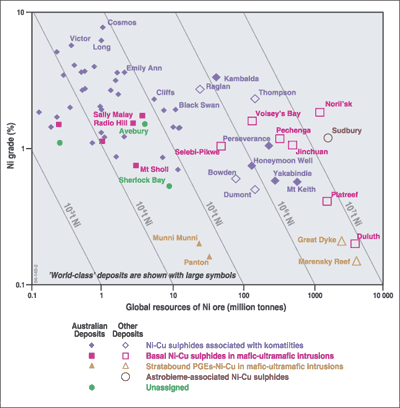
      I've attached a graph of world class Ni deposits with their grade / tonnage  relationships.  Note the slanting lines represent Ni metal tonnage versus Ni ore... always nice to be high-grade  
             

      aussi

      1. rockaur,

        once again, always enjoy learning from your posts. thank you for your efforts and sharing your knowledge on mining.

        regards,

        jsq

      2. "I've attached a graph of world class Ni deposits with their grade / tonnage relationships. Note the slanting lines represent Ni metal tonnage versus Ni ore... always nice to be high-grade "

        Question for you on reading the graph, Rockaur, does Selebi-Pikwe (in the middle of the graph) has more or less 600,000 tonnes of Ni?

        Thanks,

        ~p

        1. Tim is right. Get your receipt and they won't be used against you. You all know that is one of the reasons we bleed...Don
      3. Rockaur - thanks for sharing you knowledge with us - a few more questions.

        Why is it more common to have lower tonnage mines feasable in Ausrtalia. Or is it just a case that the occurances are smaller there?

        Or asked in reverse why does the graph imply that  you need more tonnage in areas outside of Australia to make a mine or is just that when you find Ni outside of Australia, the finds tend to be larger?

        Many thanks again

        PM

        1. PM,

          deposits occur where deposits occur....in a little while we may see a DE dot on that chart

          And no, the chart does not imply that one needs more tonnage in areas outside of Aus.  It does suggest that the lower the grade the higher the tonnage needs to be


          Rockaur  


      4. Thank you very much for your insightfulness in regards to Noront. Your posts are very much appreciated. If it is possible could you place a dot on your graph where you think NOT might be right now. Irealize its somewhat of a guess given the present info but I like your guesses. Thanks for yoour time either way.

        Ricter

      5. Roackaur - another conclusion I am drawing fro you graph, and correct me if I am wrong, our Ni grades are

        1. exceptional comparable to only the very best grades found in the world

        2. assuming cost assocaited with depth and infastructure are not issues, we need only 10 to 50 tons in the entire area play to make this a mine compared to the best Ni mones in the world in the world.

        4 the other minerals present are gravy at our location - or are they usual part of the other world class mines.

        5. If 2 is correct above, and considering that Probe and Spider already have hit to the nort east, and considering the land NOT has. woudl you know agree that the probability of this not being a mine one day is very small?

          1. Rockaur - I would prefer a open triangle to a dot on the map - do you think that is possible?

            Also I am not up on my Geo technicals so please confirm,  the vertical axis say % nickel so it seems like common sence they are refering to millions of tonnes of ore on the X axis correct?

            does millions of tons of ore = millions of tonnes of what they refer to as resources?

            1. Replying to @PM

              PM,

              triangle or a square, I'm not fussy :-)

              Resources is the term used for the broadest form of ore (meaning there is some evidence that it exists but not enough to base a minng plan on) I suggest you check out 43-101 classifications as having an understanding of them is key (IMO)

              Rockaur

              1. Replying to @Rockaur

                Rockaur:

                Always a pleaseure hearing from you, however a little confused - you indicate that " Resources means some evidence that it exists but not enough to base a minng plan on)

                I thought the graph symbols was showing active mines? So did they label the X axis wrong?

                1. Replying to @PM

                  PM,

                  Here's a quick and dirty guide of 43-101 classes. I encourage you to read up further if you're going to invest in the resource sector.

                  Rockaur

                  PS - mines will use all these classes from - resources (include all material) to proven reserves (what they're actually mining)  

                   http://www.cim.org/committees/CIMDefStds_Dec11_05.pdf

                  Figure 1 sets out the framework for classifying tonnage and grade estimates so as to reflect different levels of geological confidence and different degrees of technical and economic evaluation. Mineral Resources can be estimated by a Qualified Person, with input from persons in other disciplines, as necessary, on the basis of geoscientific information and reasonable assumptions of technical and economic factors likely to influence the prospect of economic extraction. Mineral Reserves, which are a modified sub-set of the Indicated and Measured Mineral Resources (shown within the dashed outline in Figure 1), require consideration of factors affecting profitable extraction, including mining, processing, metallurgical, economic, marketing, legal, environmental, socio-economic and governmental factors, and should be estimated with input from a range of disciplines. Additional test work, e.g. metallurgy, mining, environmental is required to reclassify a resource as a reserve.  


                  43-101

  2. Rockaur,

    I suspect you probably missed this post earlier.

    Is it possible to get a volume estimate based on the drawings that you've done?

    I am interested in all of the zones which may carry any significant minerilization. (high (net textured), massive sulphides and moderately mineralized peridotite but it would be interesting to see how big the 'total zone' is, which of course would include the low/weak mineralized zones.

    SG