Applied Optoelectronics, Inc. secures major hyperscaler wins, adding at least $253M to 2026 revenue prospects and broadening customer concentration risk.
AAOI's vertical integration and rapid capex expansion enable aggressive delivery timelines, targeting >500,000 units/month for 800G and 1.6T transceivers.
Despite management guiding for $1B in CY26 revenue (~119% growth), AAOI trades at a 7x forward revenue multiple, well below peers, implying ~42% upside.
I remain bullish on AAOI stock and have initiated a position, but execution gaps, validation delays, and customer concentration risks warrant close monitoring.
J Studios/DigitalVision via Getty Images
Investment Thesis
Last month, Iissued a detailed poston why I advised investors to be bullish on Applied Optoelectronics, Inc. (AAOI) but be extremely watchful about any gaps in the executionof Applied Optoelectronics or AOI’s strategic capacity expansion plans.
I explained reasons for my cautiously bullish outlook in last month’s post, noting how AOI had enough precedents from the past to be cautious despite the raging demand for optical networking products such as the transceivers and small-form factor pluggables that AOI makes for the data center market.
Through this month, AOI’s management has continued to announce major hyperscaler customer program wins, which carry the potential to add at least $253 million to AOI’s revenue prospects this year. This not only adds more firepower to AOI’s growth engine but broadens out the customer concentration risk for AOI that I had highlighted in my March post.
I believe these contract wins were enough for me to start dipping my toes and take my bullishness on AOI to the next level by initiating some exposure in AOI.
What AOI’s Recent Hyperscaler Wins Mean For AOI
In the last few weeks, AOI announced that it had won two major program wins for its optical transceiver business, where it would provide both 800Gbps and 1.6Tbps transceivers to the same hyperscaler customer.
At the start of March, AOI revealed that this1.6T program winwas just an“initial order,"which totaled ~$200M from “one of its long-term major hyperscale customers.” There were two implications from this announcement.
First,all shipments of this 1.6T transceiver order would be completed by the end of this fiscal year, pending product qualification allowing AOI to recognize the full extent of the $200M order backlog in this year alone.
Second,this 1.6T order that AOI won from this hyperscaler meant this hyperscaler customer would re-instate this hyperscaler as a major customer accounting for >10% of AOI’s revenues. In my previous post in March, I explained why there was a high likelihood that Amazon (AMZN) could be the most likely hyperscaler to begin ramping up its AI capex dollars towards AOI’s transceivers and pluggables. Last year,Amazon's AWS revealedthat a majority of their data center network was still using 400G solutions, so an upgrade to 800G and 1.6T optical solutions was expected. Plus, Amazon’s AWS also has anactive share warrant with AOI, which it might be executing upon, in my view.
The combination of these two implications that I stated leaves enough room for Amazon’s AWS to likely increase the purchases of more transceivers and/or pluggables from AOI. I had explained in my previous post how Amazon’s AWS could easily end up purchasing ~$400M worth of products from AOI, which is greater than the combined ~$200M AWS has already spent on awarding AOI. AOI has called these orders "initial," so there are strong hints that management has left for investors to believe that more orders could be coming.
And that’s what AWS exactly ended up doing by purchasing even more transceivers.
Just over a week ago, AOI announced that“this same customer”nowawarded AOI a contract for 800G optical transceivers. The total order was worth $53M, but what was more interesting was the agreed-upon timeline to deliver these 800G transceivers. Following product qualifications, AOI expects to ship the entire batch of 800G transceivers worth $53M by Q3 itself.
The only reason why AOI can commit to such aggressive delivery timelines for its transceivers, especially the 800G transceivers, is because of the company’s vertical integration approach to owning the entire manufacturing capability of its optical transceivers from the ground up. As revealed in theirQ4 call with analysts, AOI plans to triple its laser manufacturing capacity at its Texas location, including their production of indium phosphide, an extremely critical component in the laser manufacturing process.
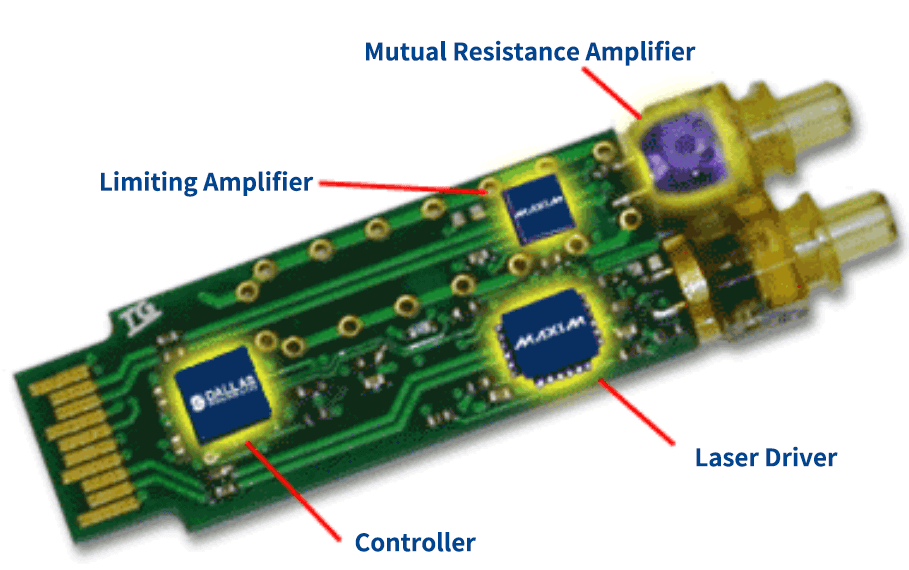
Exhibit A: Key components in optical transceivers, including the laser driver(bonelinks)
To do so, AOI is rapidly scaling its capex deployment plans to expeditiously ramp production capacity to >500,000 units of 800G and 1.6T transceivers produced per month, up from ~90,000 units of 800G transceivers being currently produced.
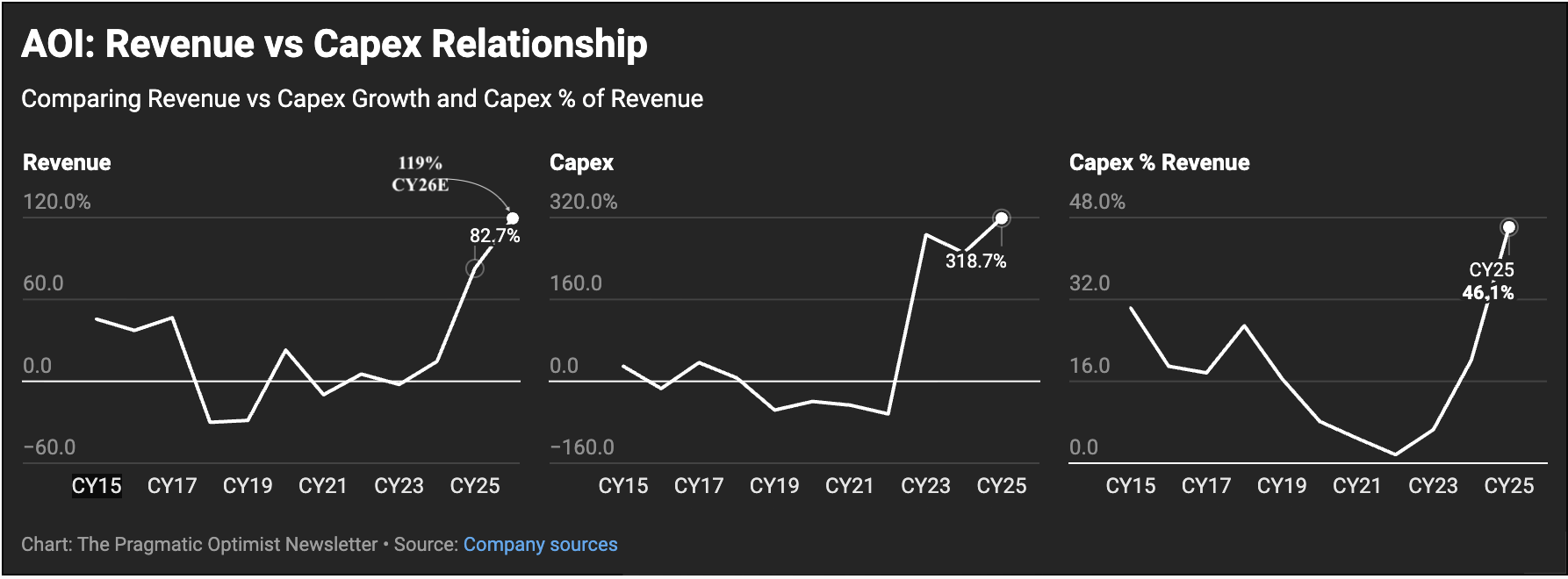
Unlike its execution gaps seen in the 2016-17 timeframe, which I noted in my March coverage on AOI, management is already rapidly scaling capex, as demonstrated in Exhibit A below, something I found encouraging amidst the backdrop of recurring backlog wins.
Exhibit B: Applied Optoelectronics is already scaling its capex plans to add more capacity and increase forward revenue growth prospects.(Company sources)
Management has not yet revealed its capex expansion plans for 2026, and this is something I will be watching closely, but for now, I am optimistic about the slate of customer wins that AOI just seems to be racking up for its optical transceivers and pluggables business.
AOI’s Valuation Multiples Are Still Not Reflective of Upside
So far, management has stated that it expects $1B in revenues in CY26. That implies ~119% top-line growth in CY26, but markets are still quite pessimistic, projecting revenues of $962M, 4% lower than what management’s revenue projections are.
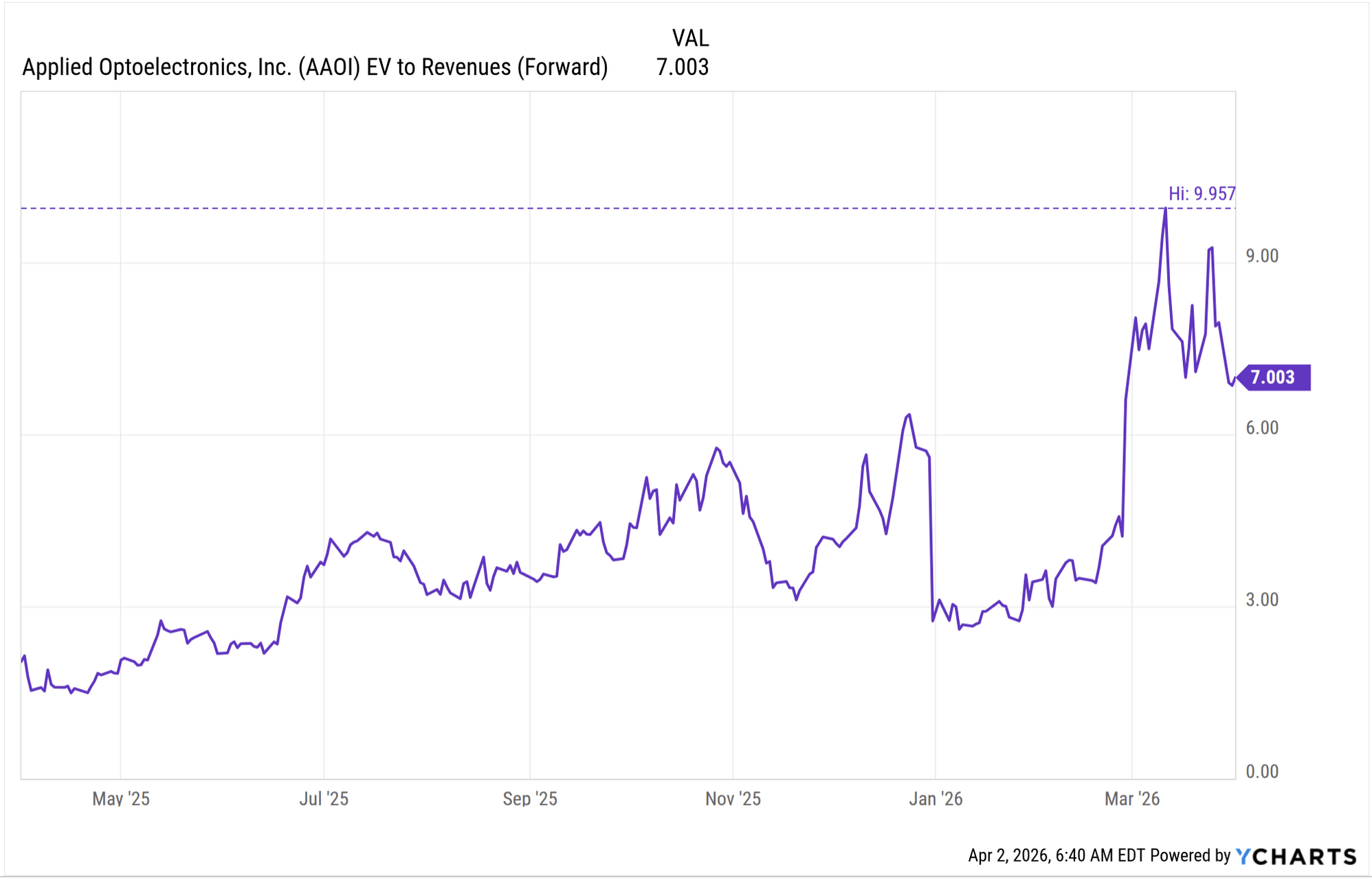
Still, if I factor in analysts’ estimates of $962M, I arrive at a forward revenue multiple of 7x. I find this extremely undervalued since I believe AOI could easily fetch a forward revenue multiple of >10x as compared to peers like Lumentum (LITE), which is currently trading at ~18x and 12x forward revenues for ~70% growth per year in FY26 and FY27.
Exhibit C: Applied Optoelectronics’s shares could easily be valued at >10x revenue multiple.(yCharts)
That scope for multiple expansions to 10x implies a minimum upside of ~42% from current levels.
Risks & Other Factors To Note
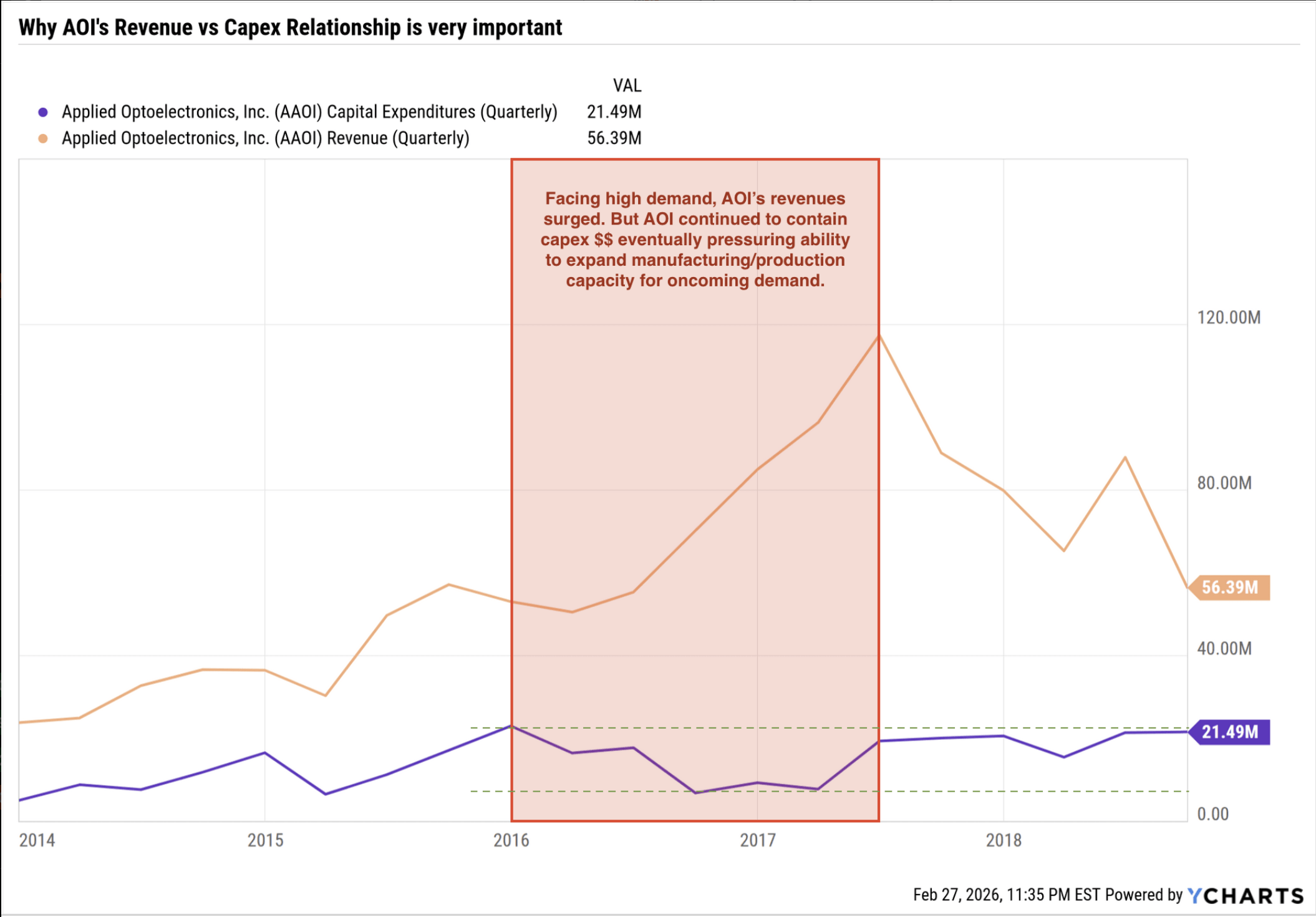
I suspect markets are still skeptical about some of the growth prospects in AOI’s business after witnessing execution gaps and concentration risks from the 2016-2017 time frame. I had explained these risks in detail in my prior posts, and investors must be mindful of the possibility of execution gaps if they invest in AOI. I am watching management’s guidelines closely on how they plan to scale their capex further, since they did not communicate these plans in theQ4 call.
Exhibit C: How AOI management did not increase capex to build capacity despite reportedly winning orders at the time.(yCharts)
Additionally, investors will note that I had previously highlighted how Microsoft (MSFT) and Oracle (ORCL) were major hyperscaler customers, introducing significant concentration risk. The likely addition of Amazon as a third hyperscaler customer might slightly broaden out the concentration risk.
Finally, I wanted to quickly add that product validation of their transceivers is critical for AOI to ship out the transceiver orders to customers and recognize backlog. In February, AOI announced that they were facing some issues in getting their 800G transceivers validated on Microsoft’s data center network, which resulted in a delay in recognizing ~$4-8M in revenue. While this is normally seen in the industry due to the wide array of accelerators (GPUs, XPUs) being deployed in data centers, investors must watch for such risks as well.
For these reasons, I refrained from upgrading AOI to a Strong Buy rating.
Takeaway
While some risks remain in the rearview mirror, the growing surge in orders being won by Applied Optoelectronics for its optical transceivers and pluggables is making the optical networking company’s outlook a lot stronger than when I last reviewed the company. Recent wins by a third hyperscaler customer suggest AI capex is continuing to increasingly flow towards beneficiaries like Applied Optoelectronics that are in control of the entire manufacturing process for their optical products.
For these reasons, I am not only reiterating my bullish view on Applied Optoelectronics, but also buying a modest position in Applied Optoelectronics.
of Applied Optoelectronics or AOI’s strategic capacity expansion plans.
I explained reasons for my cautiously bullish outlook in last month’s post, noting how AOI had enough precedents from the past to be cautious despite the raging demand for optical networking products such as the transceivers and small-form factor pluggables that AOI makes for the data center market.
Through this month, AOI’s management has continued to announce major hyperscaler customer program wins, which carry the potential to add at least $253 million to AOI’s revenue prospects this year. This not only adds more firepower to AOI’s growth engine but broadens out the customer concentration risk for AOI that I had highlighted in my March post.
I believe these contract wins were enough for me to start dipping my toes and take my bullishness on AOI to the next level by initiating some exposure in AOI.
What AOI’s Recent Hyperscaler Wins Mean For AOI
In the last few weeks, AOI announced that it had won two major program wins for its optical transceiver business, where it would provide both 800Gbps and 1.6Tbps transceivers to the same hyperscaler customer.
At the start of March, AOI revealed that this1.6T program winwas just an“initial order,"which totaled ~$200M from “one of its long-term major hyperscale customers.” There were two implications from this announcement.
First,all shipments of this 1.6T transceiver order would be completed by the end of this fiscal year, pending product qualification allowing AOI to recognize the full extent of the $200M order backlog in this year alone.
Second,this 1.6T order that AOI won from this hyperscaler meant this hyperscaler customer would re-instate this hyperscaler as a major customer accounting for >10% of AOI’s revenues. In my previous post in March, I explained why there was a high likelihood that Amazon (AMZN) could be the most likely hyperscaler to begin ramping up its AI capex dollars towards AOI’s transceivers and pluggables. Last year,Amazon's AWS revealedthat a majority of their data center network was still using 400G solutions, so an upgrade to 800G and 1.6T optical solutions was expected. Plus, Amazon’s AWS also has anactive share warrant with AOI, which it might be executing upon, in my view.
The combination of these two implications that I stated leaves enough room for Amazon’s AWS to likely increase the purchases of more transceivers and/or pluggables from AOI. I had explained in my previous post how Amazon’s AWS could easily end up purchasing ~$400M worth of products from AOI, which is greater than the combined ~$200M AWS has already spent on awarding AOI. AOI has called these orders "initial," so there are strong hints that management has left for investors to believe that more orders could be coming.
And that’s what AWS exactly ended up doing by purchasing even more transceivers.
Just over a week ago, AOI announced that“this same customer”nowawarded AOI a contract for 800G optical transceivers. The total order was worth $53M, but what was more interesting was the agreed-upon timeline to deliver these 800G transceivers. Following product qualifications, AOI expects to ship the entire batch of 800G transceivers worth $53M by Q3 itself.
The only reason why AOI can commit to such aggressive delivery timelines for its transceivers, especially the 800G transceivers, is because of the company’s vertical integration approach to owning the entire manufacturing capability of its optical transceivers from the ground up. As revealed in theirQ4 call with analysts, AOI plans to triple its laser manufacturing capacity at its Texas location, including their production of indium phosphide, an extremely critical component in the laser manufacturing process.
Exhibit A: Key components in optical transceivers, including the laser driver(bonelinks)
To do so, AOI is rapidly scaling its capex deployment plans to expeditiously ramp production capacity to >500,000 units of 800G and 1.6T transceivers produced per month, up from ~90,000 units of 800G transceivers being currently produced.
Unlike its execution gaps seen in the 2016-17 timeframe, which I noted in my March coverage on AOI, management is already rapidly scaling capex, as demonstrated in Exhibit A below, something I found encouraging amidst the backdrop of recurring backlog wins.
Exhibit B: Applied Optoelectronics is already scaling its capex plans to add more capacity and increase forward revenue growth prospects.(Company sources)
Management has not yet revealed its capex expansion plans for 2026, and this is something I will be watching closely, but for now, I am optimistic about the slate of customer wins that AOI just seems to be racking up for its optical transceivers and pluggables business.
AOI’s Valuation Multiples Are Still Not Reflective of Upside
So far, management has stated that it expects $1B in revenues in CY26. That implies ~119% top-line growth in CY26, but markets are still quite pessimistic, projecting revenues of $962M, 4% lower than what management’s revenue projections are.
Still, if I factor in analysts’ estimates of $962M, I arrive at a forward revenue multiple of 7x. I find this extremely undervalued since I believe AOI could easily fetch a forward revenue multiple of >10x as compared to peers like Lumentum (LITE), which is currently trading at ~18x and 12x forward revenues for ~70% growth per year in FY26 and FY27.
Exhibit C: Applied Optoelectronics’s shares could easily be valued at >10x revenue multiple.(yCharts)
That scope for multiple expansions to 10x implies a minimum upside of ~42% from current levels.
Risks & Other Factors To Note
I suspect markets are still skeptical about some of the growth prospects in AOI’s business after witnessing execution gaps and concentration risks from the 2016-2017 time frame. I had explained these risks in detail in my prior posts, and investors must be mindful of the possibility of execution gaps if they invest in AOI. I am watching management’s guidelines closely on how they plan to scale their capex further, since they did not communicate these plans in theQ4 call.
Exhibit C: How AOI management did not increase capex to build capacity despite reportedly winning orders at the time.(yCharts)
Additionally, investors will note that I had previously highlighted how Microsoft (MSFT) and Oracle (ORCL) were major hyperscaler customers, introducing significant concentration risk. The likely addition of Amazon as a third hyperscaler customer might slightly broaden out the concentration risk.
Finally, I wanted to quickly add that product validation of their transceivers is critical for AOI to ship out the transceiver orders to customers and recognize backlog. In February, AOI announced that they were facing some issues in getting their 800G transceivers validated on Microsoft’s data center network, which resulted in a delay in recognizing ~$4-8M in revenue. While this is normally seen in the industry due to the wide array of accelerators (GPUs, XPUs) being deployed in data centers, investors must watch for such risks as well.
For these reasons, I refrained from upgrading AOI to a Strong Buy rating.
Takeaway
While some risks remain in the rearview mirror, the growing surge in orders being won by Applied Optoelectronics for its optical transceivers and pluggables is making the optical networking company’s outlook a lot stronger than when I last reviewed the company. Recent wins by a third hyperscaler customer suggest AI capex is continuing to increasingly flow towards beneficiaries like Applied Optoelectronics that are in control of the entire manufacturing process for their optical products.
For these reasons, I am not only reiterating my bullish view on Applied Optoelectronics, but also buying a modest position in Applied Optoelectronics.