

Skip to content
Sign in

Post

Resverlogix Corp.

Prez4.5 rating from 68 members25K ptsRate

The glucose effect?

I really love the apabetalone diagram that shows the six components that may contribute to the reduced MACE: complement pathway, coagulation pathway, vascular inflammation, vascular calcification, reverse cholesterol transport, metabolism. However, it is this last component, metabolism, that is the least understood and/or established. In the diagram, it emphasizes that there was "delayed and reduced glucose absorption and endogenous glucose production."

These statements are derived from the short trial in pre-diabetic males that treated patients for 5-weeks. However, in this study there was also a decrease in the amount of total glucose disposal and no changes in fasting plasma glucose or fasting insulin were reported. In looking at the data, the changes to these glucose kinetics parameters seem pretty modest. In addition, this 5-week long study noted some interesting safety notes:

"RVX-208 treatment increased serum creatinine by 5% (P = 0.006) with a trend for reduced estimated glomerular filtration rate (eGFR) (P = 0.051, Supplementary Table 4). There was a small, but significant reduction in circulating chloride (P = 0.04) and a corresponding trend for reduced plasma sodium (P = 0.08). The red cell count was also 2%lower (P = 0.04) after RVX-208 treatment, which may be related to a direct effect of the drug on renal function. While these differences were statistically significant, it should be noted that all measures remained within normal clinical ranges. There were no significant drug effects on LFT measures when analyzed as a group (Supplementary Table 5)."

Despite the modest changes to glucose kinetics parameters in the pre-diabetic males treated for 5 weeks, the news release that discussed post-hoc analysis of diabetic patients in the 6-month long SUSTAIN/ASSURE trials was very exciting.

"Results of analysis showed that patients with DM given RVX-208 tended to have lower blood glucose vs. placebo. But specifically in patients with DM who had low HDL, the blood glucose was significantly lower following treatment with RVX-208 vs. placebo. Furthermore, the time required for RVX-208 to reduce blood glucose was not observed until at least 12 weeks following initiation of treatment." 

BETonMACE is entirely diabetic patients with low-HDL. What kind of glucose-lowering effect could the 12-36 month treatment with apabetalone elicit? This is very exciting to think about. SGLT2 inhibitors and GLP-1R agonists are glucose lowering agents with proven MACE reducing effects. Could apabetalone not only prove its worth with MACE reduction in diabetics but also offer sufficient glucose control effects to displace the use of competing SLGT2 inhibitors and GLP-1R agonist? 

BearDownAZ

Join the conversation about Resverlogix Corp.

Reply
Replies

  1. "I really love the apabetalone diagram that shows the six components that may contribute to the reduced MACE: complement pathway, coagulation pathway, vascular inflammation, vascular calcification, reverse cholesterol transport, metabolism."

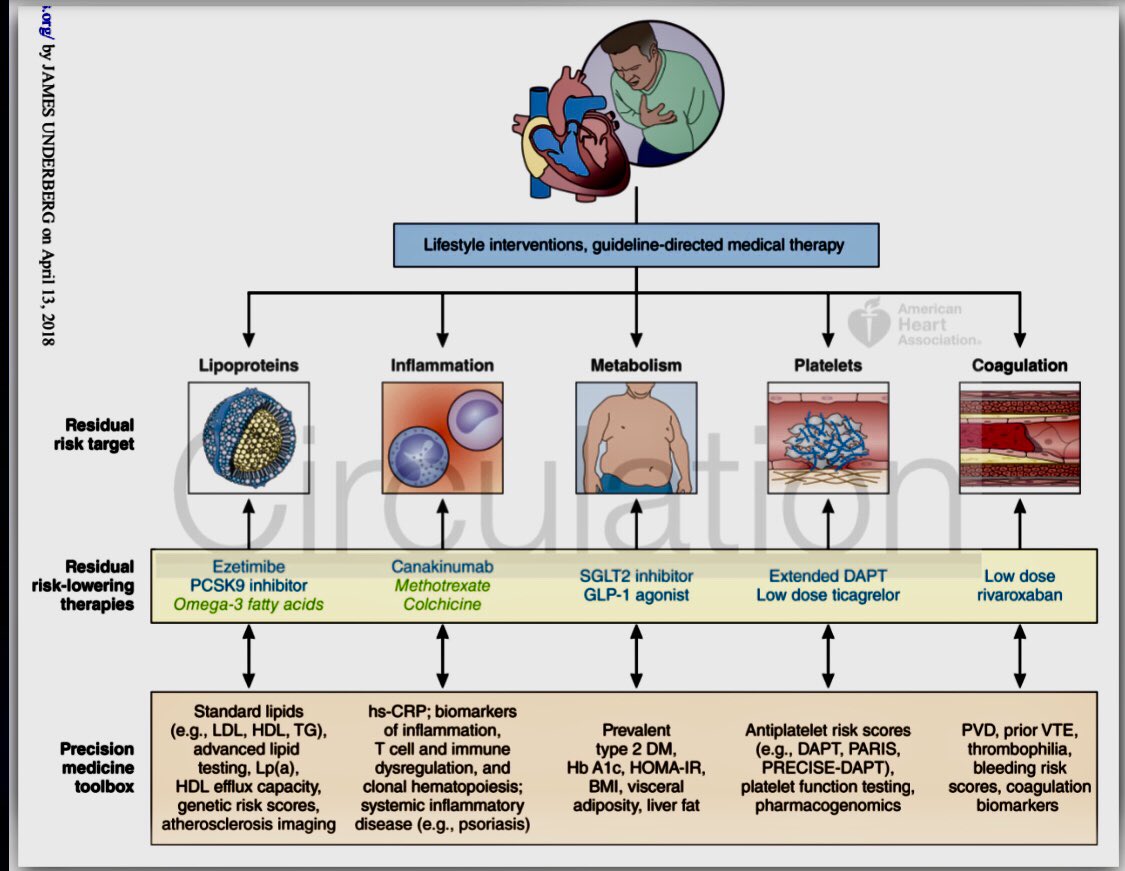
    Apabetalone hits so many different risk factors at once. A miracle pill? The apabetalone diagram linked to above on the Resverlogix web site reminds me of a figure from a paper (see below) from last year that I posted about called "A Conceptual Framework for Addressing Residual Atherosclerotic Cardiovascular Disease Risk in the Era of Precision Medicine."

    It's a short but sweet paper that summarizes the current pharmacological toolbox for dealing with residual CVD risk. It references pretty much all of the recent CVOT achievements (in blue) and those pending (in green). Since publication of this paper, the omega-3 therapy Vascepa has proven itself in REDUCE-IT and the anti-inflammatory trials with methotrexate and colchicine have both flopped. Interestingly, apabetalone has been shown in various studies to elicit beneficial effects in most, if not all, of these categories: lipoproteins (HDL), inflammation, metabolism, platelets, coagulation. Plus, apabetalone has effects to reduce the complement pathway and vascular calcification. Wouldn't it be nice to see apabetalone added to the list(s) in a future version of this figure?

    https://www.ncbi.nlm.nih.gov/pubmed/29643058

    http://circ.ahajournals.org/content/early/2018/04/10/CIRCULATIONAHA.118.035289

    Here is the text of the figure legend:

     "We propose five broad residual risk targets for secondary prevention of atherosclerotic cardiovascular disease and identify therapies either shown to be effective in large randomized trials (blue), or available for clinical use but not yet demonstrated to lower ASCVD risk (green). Precision medicine tools are proposed for each category (in many cases highly speculative) that could be used to guide selection among the potential therapies. Abbreviations - PCSK9: proprotein convertase subtilisin/kexin 9; LDL: low-density lipoprotein; HDL: high-density lipoprotein; TG: triglycerides; Lp(a): lipoprotein (a); hs-CRP: high-sensitivity C-reactive protein; DM: diabetes mellitus; Hb A1c: glycated hemoglobin; HOMA-IR: homeostatic model assessment for insulin resistance; BMI: body mass index; DAPT: Dual Antiplatelet Therapy;PARIS: Patterns of Non-Adherence to Anti-Platelet Regimen in Stented Patients; PRECISE DAPT: PREdicting bleeding Complications In patients undergoing Stent implantation and subsEquent Dual Anti Platelet Therapy; VTE: venous thromboembolism."

    beardownaz

    Resverlogix Corp.

    Framework for Addressing Residual CVD Risk

    A short but sweet paper in Circulation summarizing the current pharmacological toolbox for dealing with residual CVD risk. I really like the figure from this paper (see figure below). It references pretty much all of the recent CVOT achievements (in blue) and those pending (in...

  2. Great points!  It’s highly likely that through routine maintenance  bloodwork, many of those in the PIII and their Dr’s already know the answer(s) to that. 

  3. Another good find.


    Would think this has to do with Apabetalone's ability to remodel the mitochondria and increase the throughput of electrons down the ETC among many other things. Great to see more data on these effects.

    This is yet another sign of a very well crafted phase 3 trial. Management is very very good.

    1. "Would think this has to do with Apabetalone's ability to remodel the mitochondria and increase the throughput of electrons down the ETC among many other things."

      Pomp, please share any evidence of apabetalone's effects on mitochondrial remodeling and function of the electron transport chain that supports your statement. What you wrote is news to me and I don't recall seeing or hearing anything published or unpublished on this. 

      BearDownAZ