Skip to content
Sign in

Post

Silverado Gold Mines

Prez3.4 rating from 34 members7.1K ptsRate

House Of Rothschild Hoarding Gold In Face Of Coming Collapse?

SideNote: I believe that it was the elite who gave the orders to shut Silverado Gold Mines down, to keep the company from going into production. mburns and his minions are just peons in the bigger picture; taking orders from above to do the dirty work. GRIM

~~~~~~~~~~~~~~~~~~~~~~~~~~~~~~~~~~~~~~~~~~~

Jurriaan Maessen
Infowars.com
Jan 28, 2013

A recent appointment of Rothschild as “financial advisor” by the Board of Directors of gold exploration company Spanish Mountain Gold is yet another unmistakable indication that the ancient family is moving the world’s gold supply to both “emerging markets” and Central Banks worldwide, strengthening the family’s monopoly position when the fiat-based house of cards comes crashing down in the West. [Jim Rogers is a member of the Board]

The Board of Directors of the British Columbia based gold exploration companyappointed Rothschild to “review strategic options with the objective of maximizing shareholder value.” In July of 2012, Spanish Mountain Gold’s CEO Brian Groves boasted already that the excavation in British Colombia is a project worth “several million ounces in gold” and is backed by “an enormous network of connections globally”, Groves told Resource Clips.

Indeed, this recent appointment of Rothschild’s financial expertise (from centuries worth of experience) has increased the value of this company somewhat, propelling the gold-producing company into newer heights (or depths), depending on what end of the gold bar you find yourself. It also is a sure sign that the family is tightening its grip on gold, in both the excavation, the producing and the trading phase.

In the beginning of this century there were signs that Rothschild was starting to pull back from gold. With the announcement of Lord Jacob Rothschild that his “investment vehicle” RIT Capital Partners “has ridden the rally in gold prices but will now incrementally sell down” many observers were led to believe the ancient house was abandoning the precious stuff. Jacob Rothschild stated in 2011:

“There is I believe a growing awareness of the dangerous position which confronts many countries, particularly those in the developed world. In spite of these concerns, we continue to take advantage of areas that we believe are attractive, but we will remain cautious in terms of the quantum of capital that we allocate”.

Already in 2004 Rothschild blew the horn, announcing with a loud voice (that tends to carry far and wide throughout the world’s financial community) that the family was withdrawing from its gold-based assets. In April of 2004 theTelegraph reported:

“The investment bank that has chaired the London meetings setting the world gold price since 1919 is quitting the market.”

In 2011, an analysis makes clear how and why Rothschild manipulates the price of gold downward: https://www.youtube.com/watch?feature=player_embedded&v=fb58QELlG8I

Despite these earlier indications that Rothschild was backing away from its gold assets (which smell like the calculated diversion techniques of an experienced illusionist), the recent appointment in the Spanish Mountain project is a clear sign that gold is still foremost on the mind of the family, as it has been for many centuries past. These earlier manoeuvrings by Rothschild seem to suggest a consciously constructed effort to bring down the price of gold- with the aim of buying large quantities later on, when the price was especially low. The reason for such a move is explained by Jeff Thomas in February 2012, when he wrote:

“Many economists project that, following the crashes of the Euro and the dollar, a return to gold-backed currencies would appear as a world trend. This is only natural, as the fiat currency concept would have been shown to be the farce that it is.”

For this reason, Thomas argued, the hoarding of gold is being done with the aim of redistributing it later on to those nations (or supra-nations, such as the EU and China) the elite have destined to be the future global engines after the old one has been discarded:

“It is entirely possible that all currencies could receive a shake-up, and an entire worldwide system of gold-backed currencies may develop. If this were to occur, the countries that held the largest amounts of gold at that time would be out in front economically.”

This indeed seems to be the case. As Edmond de Rothschild’s France-based asset management company analyzes for 2013, the so called “emerging markets” are increasingly scooping great chunks of gold from the world’s supply:

“It is (…) reassuring to see that physical demand has started the year well with an increase in Chinese and Indian buying. The Chinese are buying before the Lunar New Year while Indians seem to be anticipating higher duties on imported gold. At the same time, central bank buying continues. They bought 536 tonnes in 2012 (+17% on record 2011 levels) or 13% of total demand.”

Another document issued by Edmond de Rothschild’s “Goldsphere”-enterprise analyzes the global gold-trade, the buyers, the sellers, the winners and the losers. In one of its assessments the global elite recognizes that European nations are reluctant to sell their gold stocks and the current trend is a continuous rover of gold towards the East:

“European countries are in no rush to sell their bullion reserves as they are small in value compared to their debt problems and some of the gold might already have been pledged in collateralised loans.”

While all the major strongholds of the elite are being abandoned in the US, new lairs are being set up in China. The document concludes by saying that gold-producing companies and miners are not sufficiently riding the wave of ever-rising gold prices:

“All the recent meetings we have had with gold companies tend to confirm the industry’s acceptance that gold mines and gold projects have to be better managed so as to get shareholder returns more in line with the current strong gold price. And some projects have in fact already been postponed or cancelled because of insufficient profitability.”

This puts the recent “appointment” of Rothschild by Spanish Mountain Gold somewhat into perspective doesn’t it? It seems the ancient House of Rothschild has feigned a retreat from gold in the beginning of this century, only to then snatch it again at a good prize and move it into the East- their future global engine. When Baron Benjamin de Rothschild was asked by Israeli newspaperHaaretz what the family’s intentions are in regards to China, he answered unhesitatingly “to increase our focus in that region”.

As the elite’s engine of control is incrementally deconstructed in the West, the world’s gold is gradually moving towards its new engine in the East.

Rothschild to China

Join the conversation about Silverado Gold Mines.

Reply

Replies

  1. Brief history of the London house, NM Rothschild & Sons

    https://www.rothschildarchive.org/.../n_m_rothsc...

    N M Rothschild and Sons specialised in the finance of mining companies*

    ~~~~~~~~~~~~~~~~~~~~~~~~~~~~~~~~~~~~~~~~~~~~~~~~~~

    The Rothschilds, LBMA, and Gold

    www.bibliotecapleyades.net/sociopolitica/esp_sociopol_rothschild03.htm

    ... negotiating gold lease terms for central banks and mining companies


    ~~~~~~~~~~~~~~~~~~~~~~~~~~~~~~~~~~~~~~~~~~~~~~~~~~

    N M Rothschild & Sons

    With Nathan’s death in July 1836, the City of London lost a financier whose name had become legendary in his own lifetime. However, N M Rothschild & Sonswould continue to prosper and grow at the centre of the London financial world, and his sons continued the business under the name N M Rothschild & Sons.

    The business specialised in foreign loan issues, bullion trading and the finance of public utility companies, notably foreign railways, while maintaining in the first half of the nineteenth century a certain volume of merchant trade in commodities such as quicksilver, tobacco, sugar and cotton. The firm operated through a worldwide network of agents, among them August Belmont (New York, est. 1837), Weisweiller & Bauer (Madrid, est. 1835), Lionel Davidson (Valparaiso, est. 1843), and S Bleichröder (Berlin, documented from 1850).

    The firm acquired the lease of the Royal Mint Refinery in 1852, refining bullion until the sale of the business in 1967. In the late nineteenth century N M Rothschild and Sons specialised in the finance of mining companies, notably De Beers, through the Exploration Company of which the bank was a founder, and also acted as bankers to the governments of Brazil, Chile and Egypt.

    In January 2010, Nathaniel Philip Rothschild bought a substantial share of the Glencore mining and oil company's market capitalisation. He is also buying a large share of the aluminium mining company United Company RUSAL.[64]

    During the 19th century, the Rothschilds controlled the Rio Tinto mining corporation, and to this day, Rothschild and Rio Tinto maintain a close business relationship.[65]

    Rio Tinto is primarily organised into five operational businesses, divided by product type:[37]

    • Rio Tinto Copper – copper and byproducts such as gold, silver, molybdenum, and sulphuric acid; future home of nickel operations if developed
    • Rio Tinto Alcan – aluminium, bauxite and alumina
    • Rio Tinto Energy – coal and uranium
    • Rio Tinto Diamonds & Minerals – diamonds, industrial minerals such as borax, salt and gypsum and titanium dioxide
    • Rio Tinto Iron Ore – iron ore and iron

    In 2012, RIT Capital Partners announced it is to buy a 37 per cent stake in a Rockefeller family wealth advisory and asset management group. The deal, focusing on asset-management, marks the first time that these two well-known families have collaborated.[66] Commenting on the deal, David Rockefeller, a current patriarch of Rockefeller family, said: "The connection between our two families remains very strong."[67]

    N M Rothschild & Sons Limited Key Developments

    N M Rothschild & Sons Limited Presents at African Mining Indaba 2016, Feb-09-2016 02:30 PM
    Jan 5 16

    N M Rothschild & Sons Limited Presents at African Mining Indaba 2016, Feb-09-2016 02:30 PM. Venue: Cape Town, South Africa. Speakers: Christopher Coleman, Managing Director; Co-Head of Investment Banking, Rothschild.

    Updates To Strategic Review
    Dec 19 15

    Empresas ICA, S.A.B. de C.V. (BMV:ICA *) has announced some updates to the on-going strategic review. Over the next 30 to 60 days, with the help of N M Rothschild & Sons Limited and FTI Consulting, Inc. (NYSE:FCN), Empresas will work on a cost-cutting plan and a restructuring plan. Empresas expects that the initial restructuring plan will be finalized by mid-February 2016. Empresas has also begun the process of engaging with its creditors and other stakeholders. While this review is ongoing, Empresas' priority will be to serve the clients and to continue providing construction and concession-management services. Empresas has decided that the company will not pay the interest payment of $31 million due on November 30, 2015.

    ICA Explores Alternatives
    Oct 29 15

    Empresas ICA, S.A.B. de C.V. (BMV:ICA *) announced that it has engaged N M Rothschild & Sons Limited as part of its financial advisory team. They have been appointed to assist with an evaluation of the current operational situation of Empresas and to help with an assessment of various alternatives in order to improve Empresas's long-term performance and prospects. As part of this assessment, ICA is exploring with Rothschild various strategies to improve its liquidity and reduce its leverage. ICA does not have any plans to file for concurso mercantil or any other insolvency proceeding.

    1. Jewish banking houses were instrumental to the process of capital formation in the United States in the late 19th and early 20th century.[11] Modern banking in Europe and the United States was influenced by Jewish financiers, such as the Rothschild family and Warburg family, and Jews were major contributors to the establishment of important investment banks on Wall Street.

      In the middle of the 19th century, a number of German Jews founded investment banking firms which later became mainstays of the industry. Most prominent Jewish banks in the United States were investment banks, rather than commercial banks.[12] Jonathan Knee postulates that Jews were forced to focus on the development of investment banks because they were excluded from the commercial banking sector.[13] In many cases, the efforts of Jewish immigrants to start banks was enabled due to the substantial support of their Jewish banking connections in Europe.[14]

      Several major banks were started following the mid-19th century by Jews, including Goldman Sachs (founded by Samuel Sachs and Marcus Goldman), Kuhn Loeb (Solomon Loeb and Jacob H. Schiff), Lehman Brothers (Henry Lehman), Salomon Brothers, and Bache & Co.(founded by Jules Bache).[15]

      The firm of Kuhn, Loeb & Co. played a prominent role in the area of railway finance.

      In the late 1860s, The Seligman family transitioned from merchandising to banking, setting up operations in New York, St. Louis, and Philadelphia as well as Frankfurt, Germany, London and Paris that gave European investors an opportunity to buy American government and railroad bonds. The firm's conservative policies allowed it to ride out the panic of 1873. [16] In the 1880s the firm provided financing for French efforts to build a canal in Panama as well as the subsequent American endeavor. In the 1890s J.& W. Seligman & Co. Inc. underwrote the securities of newly formed trusts, participated in stock and bond issues in the railroad and steel and wire industries, and invested in Russia and Peru, and in American in shipbuilding, bridges, bicycles, mining, and other enterprises. In 1910 William C. Durant of the fledgling General Motors Corporation gave control of his company to the Seligmans and Lee, Higginson & Co. in return for underwriting $15 million worth of corporate notes.[17][18][19]

      Lehman Brothers entered investment banking in the 1880s, becoming a member of the Coffee Exchange as early as 1883 and finally the New York Stock Exchange in 1887.[20][21] In 1899, it underwrote its first public offering, the preferred and common stock of the International Steam Pump Company. Despite the offering of International Steam, the firm's real shift from being a commodities house to a house of issue did not begin until 1906. In that year, under Philip Lehman, the firm partnered with Goldman, Sachs & Co.,[22][23] to bring the General Cigar Co. to market,[24] followed closely by Sears, Roebuck and Company.[24] During the following two decades, almost one hundred new issues were underwritten by Lehman, many times in conjunction with Goldman, Sachs. Among these were F.W. Woolworth Company,[24][25] May Department Stores Company, Gimbel Brothers, Inc.,[26] R.H. Macy & Company,[26] The Studebaker Corporation,[25] the B.F. Goodrich Co. and Endicott Johnson Corporation.

      In the 1890s, a time of severe depression, Populist politicians decried the influence of a Jewish conspiracy to control the world's gold supply at the expense of honest farmers. . The fiery orator Mary E. Lease denounced President Grover Cleveland "the agent of Jewish bankers and British gold."[27] The Populist movement almost totally collapsed after 1896, and the bitter rhetoric largely disappeared as prosperity returned.

      After 1920 many banks which had their roots in the German-Jewish immigrant community began to lose their Jewish character. They no longer filled the ranks of management nor sought their capital needs from within the community. By the 1930s, Jewish presence in the private investment banking had diminished sharply.[28]

      Jacob Schiff was perhaps the most influential Jewish banker in the United States at the end of the 19th century. He was president of Kuhn Loeb and financed railroads such as the Pennsylvania Railroad and the Louisville and Nashville Railroad, and he took part in the reorganization of the Baltimore & Ohio Railroad in 1896-99, and at various times aided the Westinghouse Electric Company, and the Western Union Telegraph Company.[29]

      1. Refering to the bankers President Andrew Jackson once said, “I have had men watching you for a long time and when you won, you divided the profits amongst you, and when you lost, you charged it to the bank. You tell me that if I take the deposits from the bank and annul its charter, I shall ruin ten thousand families. That maybe true, gentlemen, but that is your sin! Should I let you go on, you will ruin fifty thousand families, and that would be my sin! You are a den of vipers and thieves, and by the Eternal, I will rout you out.” [this would include the peon mburns]

        1. President George Washington Sound Money

          In 1787 letter to Jabez Bowen-

          "But if in the pursuit of the means we should unfortunately stumble again on unfunded paper money or any similar species of fraud, we shall assuredly give a fatal stab to our national credit in its infancy. Paper money will invariably operate in the body of politics as spirit liquors on the human body. They prey on the vitals and ultimately destroy them. Paper money has had the effect in your state that it will ever have, to ruin commerce, oppress the honest, and open the door to every species of fraud and injustice."


          George Washington economics quote

          john adams debt

          Thomas Jefferson national debt

        2. "For we are opposed around the world by a monolithic and ruthless conspiracy that relies on covert means for expanding its sphere of influence--on infiltration instead of invasion, on subversion instead of elections, on intimidation instead of free choice, on guerrillas by night instead of armies by day. It is a system which has conscripted vast human and material resources into the building of a tightly knit, highly efficient machine that combines military, diplomatic, intelligence, economic, scientific and political operations.

          Its preparations are concealed, not published. Its mistakes are buried not headlined. Its dissenters are silenced, not praised. No expenditure is questioned, no rumor is printed, no secret is revealed."

          Author: President John F. Kennedy
          Date: April 27, 1961
          Location: Waldorf-Astoria Hotel
          Title of Speech: "The President and the Press"

            1. Replying to @GRIM REAPER

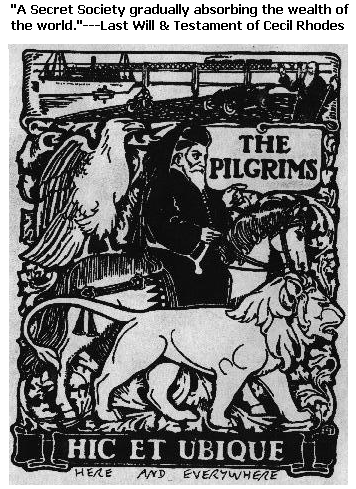
              (Editors Note: This is Mr. Savoie's outstanding exposé of the Pilgrim Society, an organization that has been conspiring to rule the world for over 100 years.To view all six parts, please follow these links: [1] [2] [3] [4] [5] [6] - JSB)

              "Cecil John Rhodes," The American Monthly Review of Reviews, New York, May 1902, pages 556-557 describes the life’s work and globalist ambitions of South African diamond cartelist Cecil Rhodes, a man financed both by The Crown and the Rothschilds, out of whose wills came the subversive Rhodes Scholars, the Royal Institute for International Affairs in London, the Council on Foreign Relations in New York, and others, all under the concealed supervision of the controlling organization - The Pilgrims of Great Britain and The Pilgrims of the United States, the hidden Senate of the transatlantic super-rich, founded in 1902 and 1903, respectively, drawing into itself the prominent "robber baron" dynasties of the 19th century and the financiers of the centuries old British Empire. Their last ace in the hole for global control is the United Nations, and if it fails, they fail.

              http://www.silverbearcafe.com/private/01.11/silverstealers.html

              ~~~~~~~~~~~~~~~~~~~~~~~~~~~~~~~~~~~~~~~~~~~~~~~

              SideNote: Over the weekend, I've read half of this lengthy article (above) to suppress Silver as real money by the rich, and found it to be very interesting read. This could be the reason why JFK was eliminated?

              On June 4, 1963, JFK introduced Executive Order 11110 "to issue silver certificates against any silver bullion, silver" This Executive Order worked against the elite's secret plans to do away with Silver as money. This Executive Order also stripped the power away from the Federal Reserve to create money. JFKs Executive Order can be found here http://www.presidency.ucsb.edu/ws/index.php?pid=59049 and further explaination can be found here http://rense.com/general76/jfkvs.htm

              GRIM

              1. Replying to @GRIM REAPER

                • March 28, 2016

                While I have closely researched the silver market for more than 30 years, uncovering more original findings (including silver’s price manipulation) than anyone, I fully admit that I did not immediately see the monumental change that began to occur five years ago. This astonishing development that had begun in 2011 did not come clear to me until late 2013.

                I discovered that the largest U.S. bank, JPMorgan Chase, began to accumulate massive amounts of physical silver starting in 2011 and has continued that accumulation to this day. All told, I believe JPMorgan has acquired somewhere between 400 and 500 million ounces, the largest privately held stockpile of silver in history.

                What this means is that the future price of silver is now destined to move far higher in price than anyone can imagine. I wasn’t looking for something to come along that would supersede my already ultra-bullish outlook on silver, but that is what occurred. That’s because the obvious motive JPMorgan has whenever it acquires a large investment position is to profit on that position to the greatest degree possible. And since JPMorgan is now in position to profit enormously when silver prices soar, that means anyone holding silver will profit as well.

                How did JPMorgan come to acquire hundreds of millions of ounces of physical silver? It was a circuitous route, beginning in the financial crisis of 2008 when JPMorgan took over a failing Bear Stearns, then the largest short seller in COMEX gold and silver futures contracts. JPMorgan stepped smoothly into Bear Stearns’ role as the main silver and gold price manipulator and proceeded to drive the price of silver from $21 in March 2008 to under $9 through massive short sales on the COMEX. In the years that followed, JPMorgan continued its new role as the largest short seller in COMEX silver and reaped billions of dollars in ongoing profits by shorting silver on price rallies and buying back those short positions after it rigged the prices lower.

                With manipulative intent and practice, JPMorgan continued to make illicit profits on the short side of COMEX silver until late 2010. Then a developing physical shortage in the silver market drove prices to almost $50 by the end of April 2011. JPMorgan was not prepared for the developing physical shortage and the price run up nearly crippled the bank. That’s when it dawned on JPM that it was on the wrong side (the short side) of silver and the bank resolved to get on the right side – the long side. But first, JPMorgan had to get off the short side.

                JPM did this by causing silver futures prices to plummet with the full consent of the COMEX and government regulators at the CFTC, a process that has continued to this day. JPM regained control of silver prices on May 1, 2011 and by driving prices sharply lower killed off the developing investment demand that was causing the physical shortage. But while JPMorgan regained control of silver prices on the COMEX, it could not buy as many futures contracts as it desired without causing prices to soar – it needed another angle. That other angle was for the bank to begin to buy physical silver while it continued to sell short COMEX paper futures contracts. This way, JPMorgan could have its cake and eat it too – continuing to profit on paper short sales while acquiring physical silver at the depressed prices it had created. I labeled JPMorgan’s actions as the perfect crime in a public article in December 2014.

                http://www.silverseek.com/commentary/perfect-crime-13944

                JPMorgan behaved illegally in manipulating prices lower while accumulating all the physical silver it could. However, there is no limitation on what any entity can hold in a physical commodity position. Limitations exist (loosely enforced) on what traders can hold in futures and other derivatives, but no such limitations apply to physical positions. This cleared the way for JPMorgan to hold as much physical silver as it could. Since the price of COMEX silver determines the price for silver throughout the world, this put JPMorgan in the catbird’s seat, by enabling it to depress the COMEX price and then scooping up physical silver in prodigious quantities and at ridiculously depressed prices.

                As far as the forms of physical silver that JPMorgan has acquired over the past five years, the simple answer is in any form that could be acquired in size. Most of the silver that JPMorgan acquired was in the form of 1,000 ounce bars, the industry standard for silver and the kind deliverable on COMEX futures and held in the worlds silver ETFs and other investment vehicles. JPMorgan has secured hundreds of millions of ounces from the big silver ETF, SLV, and in deliveries against COMEX futures contracts, some of it held in JPM’s own COMEX warehouse, which opened for business in May 2011 and is now the largest COMEX silver warehouse (confirming my timeline). Their warehouse now holds 70 million ounces and is their most visible holding. Harder to see is the 100 million ounces they likely have in their London warehouse where they moved out 100 million ounces of other people’s silver to make room for their own in 2012.

                But JPMorgan has also bought silver in the form of American Silver Eagles and Canadian Maple Leafs to the tune of 150 million ounces over the past five years, quickly re-melting the coins into 1,000 ounces bars because it would be impossible to sell so many coins in coin form. In fact, the curious riddle of record sales of Silver Eagles and Maple Leafs over the past five years coupled with bona fide reports of weak retail sales of these coins was an important clue that someone big was buying many of the coins, roughly 50% of all such coins sold.

                When I say I wasn’t looking to uncover the most bullish development ever in silver that is an understatement. But as an analyst, I look to the data first and foremost. Not only has that data tipped me off to what JPMorgan has been up to, the continuing flow of public data confirm my conclusion daily. Everything from COMEX silver warehouse movement, deliveries against futures contracts, changes in the big silver ETF, SLV, sales of silver coins from the U.S. and Royal Canadian Mints point to the massive accumulation of silver by JPMorgan. They are positioned to make $100 billion or more in a runaway silver market. They will make $1 billion on a $2 rise in silver.

                The very last thing I would be interested in at this stage of my life, is to come up with some wacky premise that threatened to undermine many of my previous findings. I studiously avoid anything that would damage a reputation I have spent decades constructing. On the other hand, if I have discovered the most shockingly bullish silver development ever, how could I not proclaim it far and wide?

                I have discovered that JPMorgan has accumulated more physical silver than any private entity in history and I don’t care if great numbers of observers come to agree with me or not. I will openly discuss this with anyone who has questions, but most importantly I would remind you that if I am correct in my assertion anyone who aligns themselves with what JPMorgan has done and buys silver will most likely reap financial rewards of truly amazing proportions.

                http://www.commoditytrademantra.com/silver-trading-news/five-years-that-have-changed-the-silver-market-forever/

                (((((( GOT SILVER )))))) (((((( KEEP STACKING)))))) GRIM REAPER