Skip to content
Sign in

American Fusion Inc.

$AMFN · OTCQB

Official AGORACOM Client Hub

American Fusion Inc.

  • United StatesOTCQB:AMFN

American Fusion is developing the Texatron™, a compact fusion engine designed to work in pulses, now in testing in Texas. It plans to sell the power to data centers and industry.

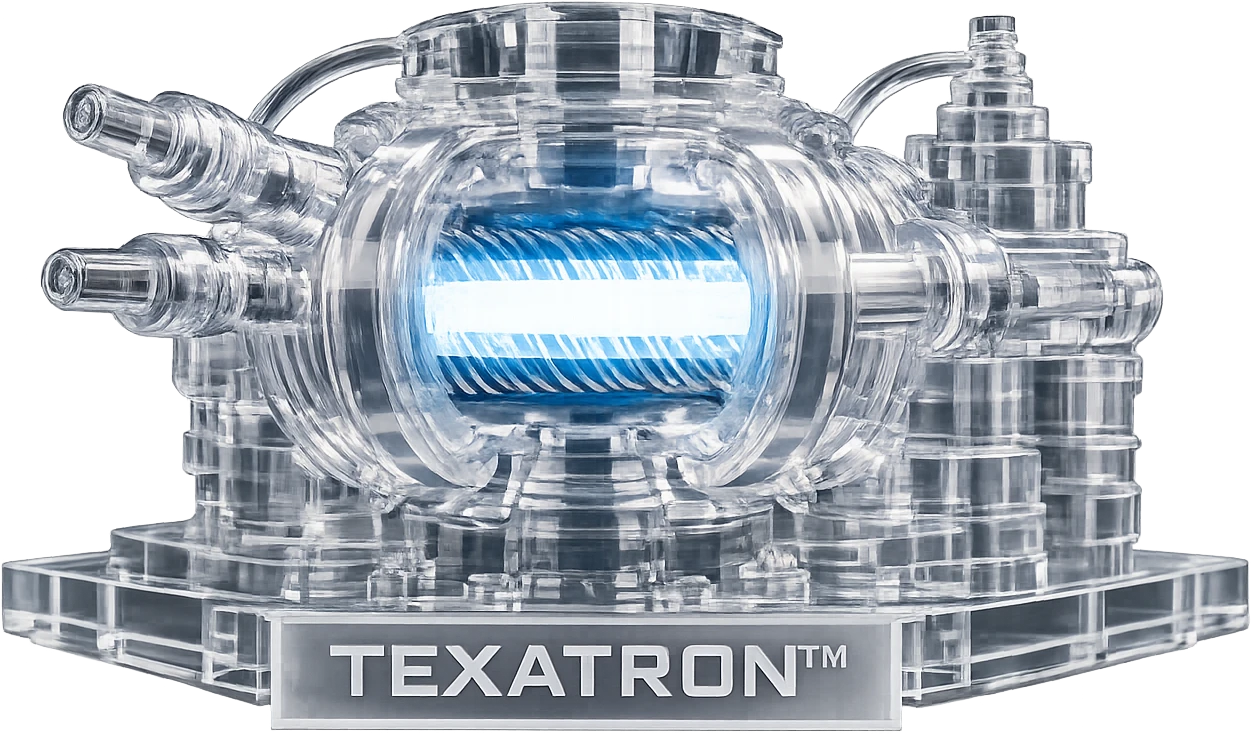
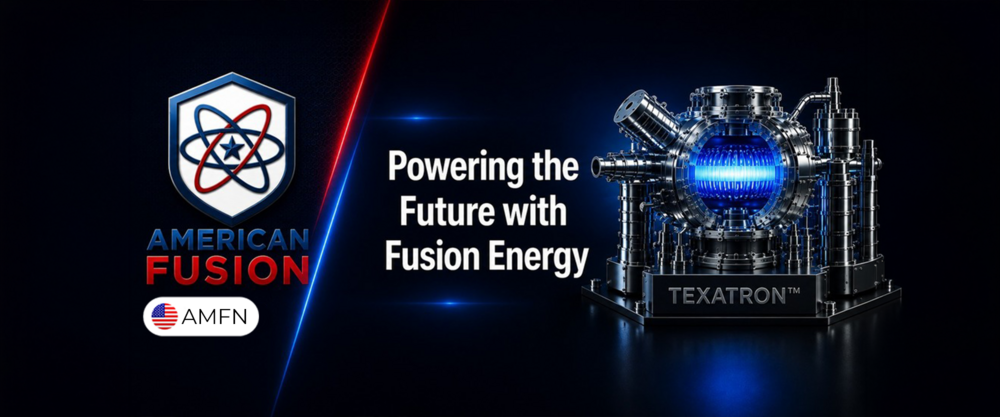
The Texatron™, a compact pulsed fusion engine in testing in Texas.

Issued on behalf of American Fusion Inc. Disclosure

Sentiment

No picks yet

Sign in to say how you feel about this company.

About

American Fusion Inc. is a Texas company whose shares trade on the OTCQB Venture Market under the symbol AMFN. It was formed when Renewal Fuels, Inc. acquired Kepler Fusion Technologies Inc. on February 27, 2026; the American Fusion name and the AMFN ticker took effect on March 19, 2026, and the shares moved up to the OTCQB on August 21, 2026. Its administration office is in Southlake, Texas.

The company is developing the Texatron™ Fusion Engine™, a compact fusion system invented by its Chief Technology Officer, plasma physicist Dr. John E. Brandenburg. Instead of holding hot plasma steadily, the Texatron forms a ring of plasma and squeezes it with brief, powerful magnetic pulses, several times a second. It is designed to burn deuterium and helium-3, a reaction that releases most of its energy as charged particles, and the company aims to turn that energy straight into electricity, without steam or turbines. Texas registered twelve Texatron research model classes in July 2026 for research and development only. Testing began at Texas Tech University that month, and the company has since reported peak plasma pressures of about 100,000 atmospheres and hotter, denser plasmas that stayed stable. Fusion ignition, net energy gain and direct conversion of fusion energy into electricity have not been demonstrated.

American Fusion plans to own and run its Texatron units and sell the electricity under long-term agreements, a model it calls Power-as-a-Service. It has delivered four commercial proposals and is preparing proposals for at least four more Texas data center projects; no definitive agreement has been announced. It had 151 U.S. patent applications pending in September 2026. An independent reviewer evaluated the technology on site in November 2026; the company expected the final report before the end of November, subject to completion of the review. The company is evaluating a move to the Texas Stock Exchange, Nasdaq or the New York Stock Exchange, but has not chosen one, and has said a reverse stock split may be needed to meet a listing's minimum bid price. It has asked an Alaska court to vacate a legacy default judgment from its time as Renewal Fuels; the motion was undecided as of its last disclosure. Its third-quarter 10-Q reports substantial doubt about its ability to continue as a going concern.

Company facts

Exchange
OTCQB
Symbol
AMFN
Industry
Energy & Environment
Shares outstanding
1,652,284,363 - 11/13/2026

The Big Picture

American Fusion has one product, the Texatron™ Fusion Engine, and four parts of the work around it: the engine and its patents, a testing program in Texas, a plan to sell the power it makes, and new facilities and capital to carry the program forward.

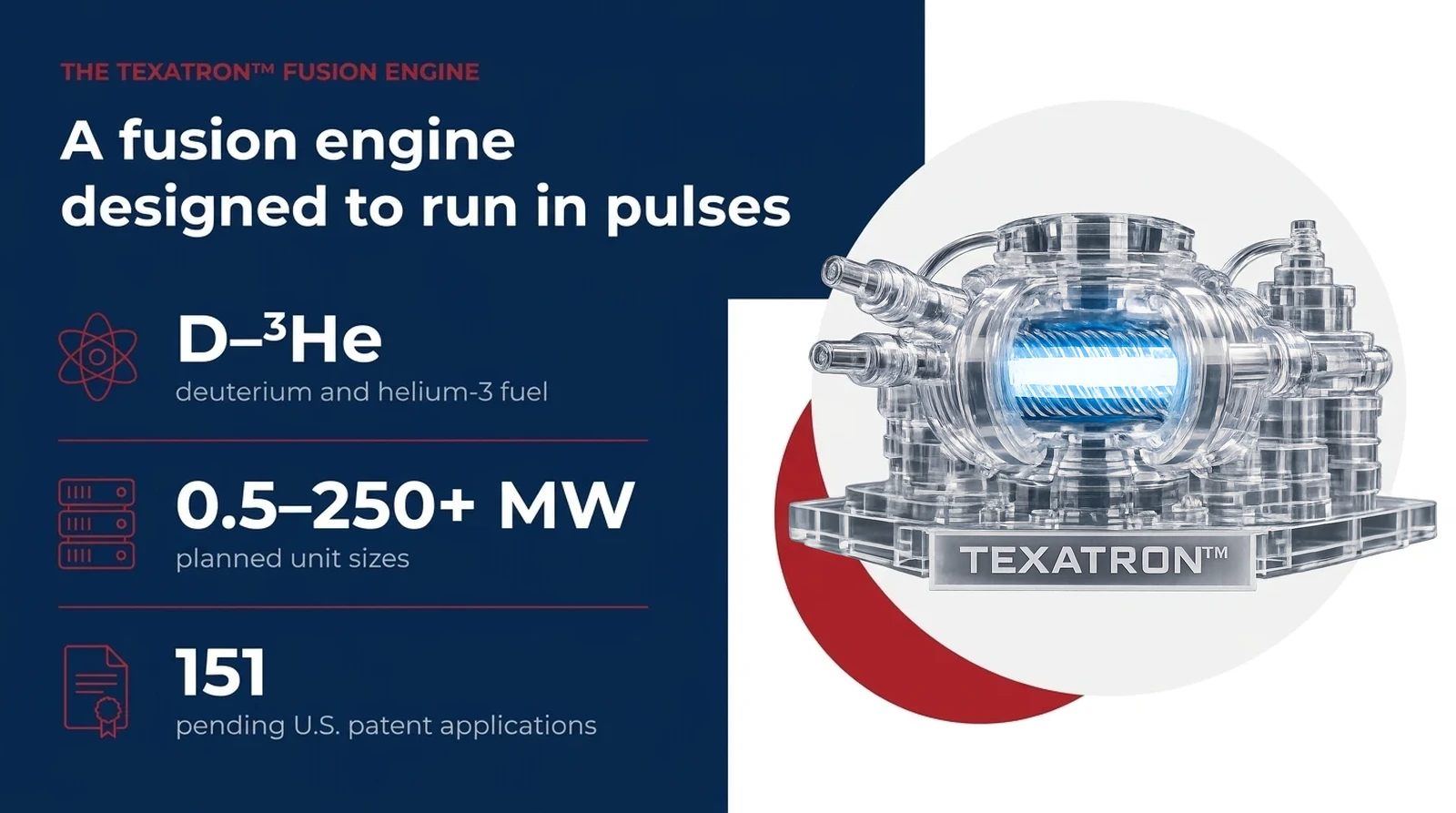
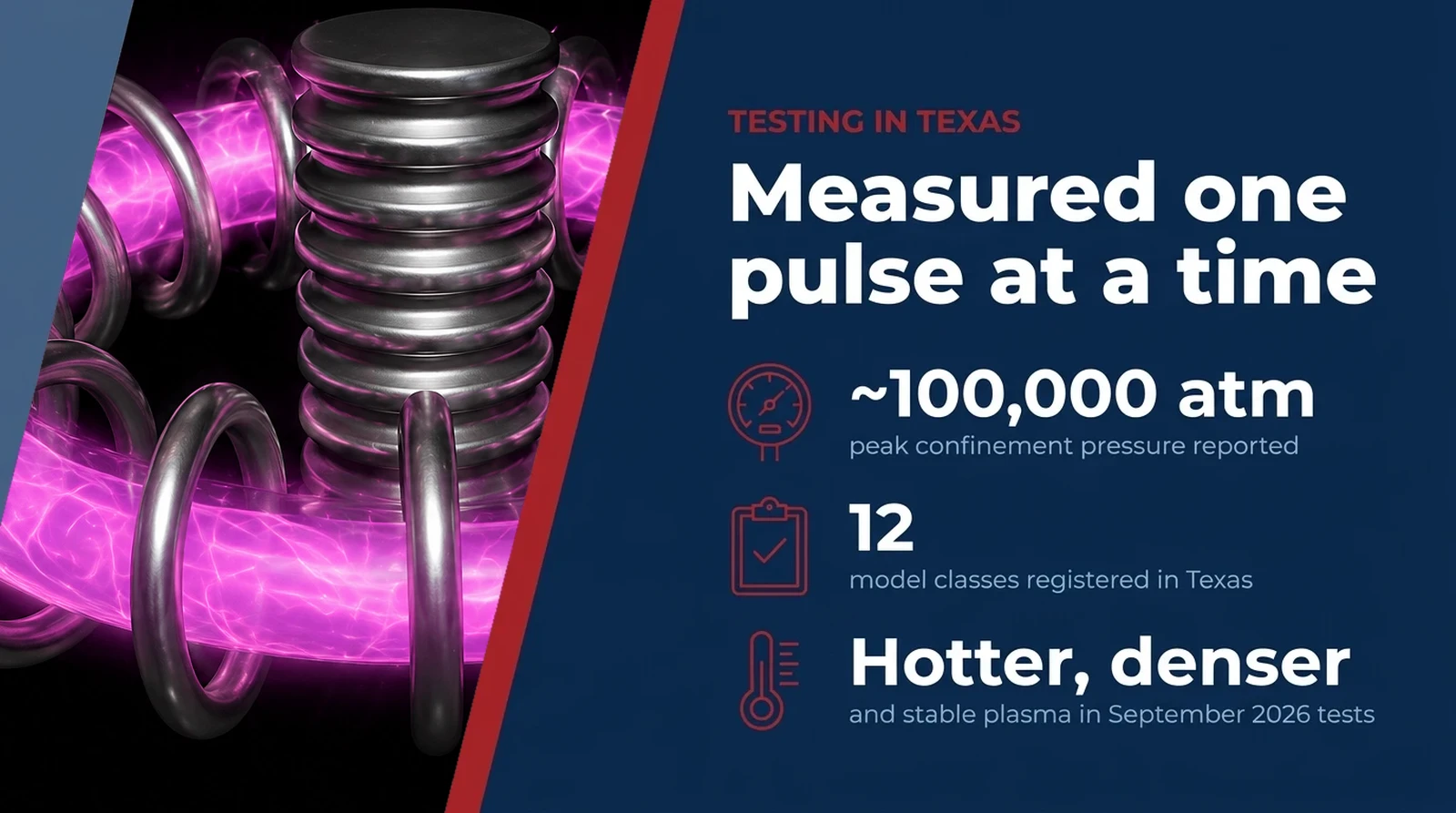
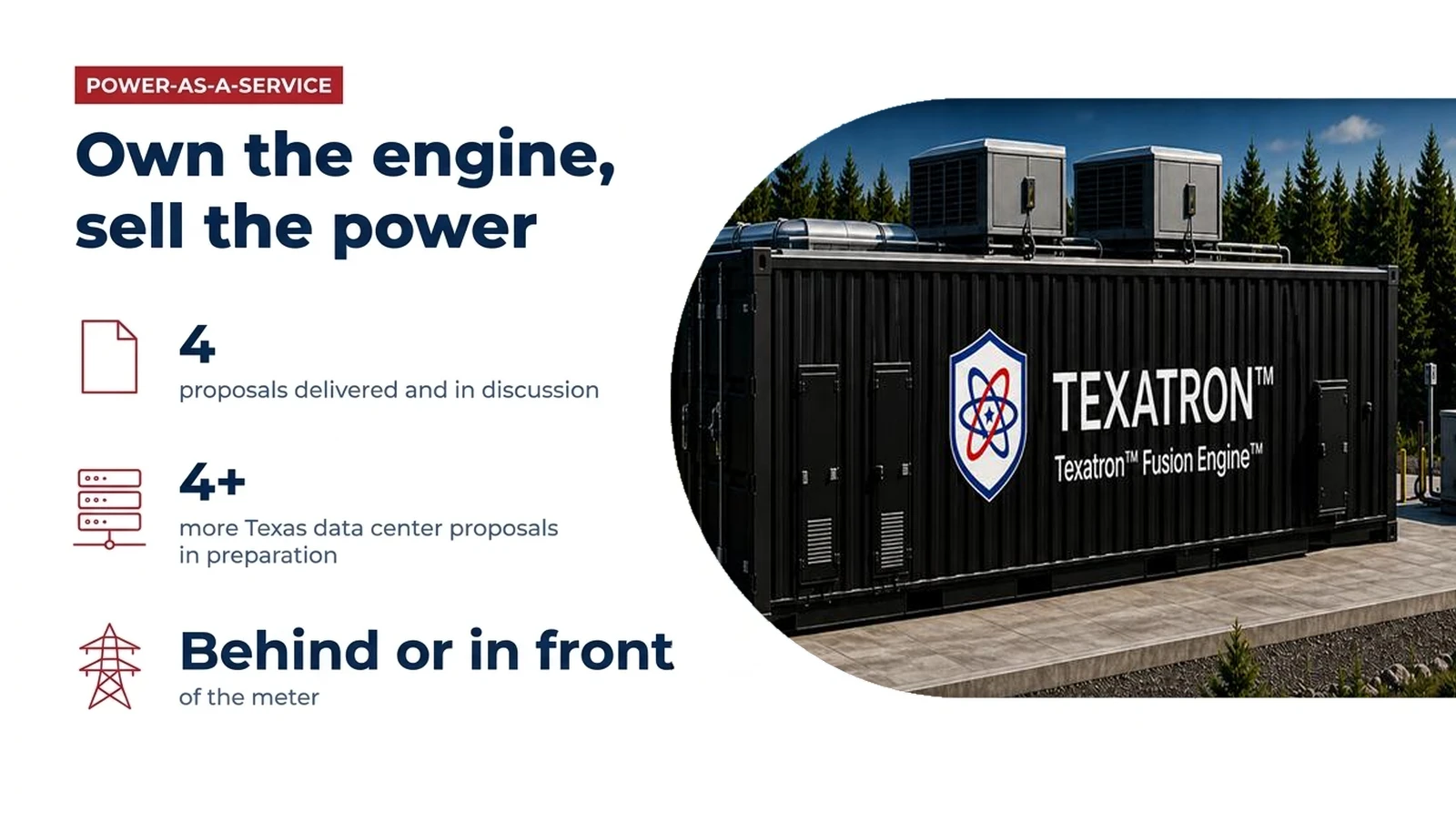
The Texatron™ Fusion Engine: a fusion engine designed to run in pulses; D–³He, deuterium and helium-3 fuel; 0.5–250+ MW, planned unit sizes (Nov 2026 deck; none built at these ratings); 151 pending U.S. patent applications (Sep 2026; applications, not issued patents). Company rendering. Fusion ignition, net energy gain and direct conversion of fusion energy into electricity have not been demonstrated.Testing in Texas: measured one pulse at a time; ~100,000 atm peak confinement pressure reported (Aug 2026); 12 model classes registered in Texas (research and development only, not certification); hotter, denser and stable plasma in September 2026 tests. Company illustration. Test results are as reported by the company; they are not independent validation. High pressure alone does not show that fusion has occurred.Power-as-a-Service: own the engine, sell the power; 4 proposals delivered and in discussion (Oct 2026); 4+ more Texas data center proposals in preparation; behind or in front of the meter. No definitive agreement has been announced. Company rendering of a planned Texatron unit.
  1. Texatron™ engine

    A compact, pulsed fusion system built around what the company calls a Rifled Toroidal Pinch: a chamber with spiral grooves that is meant to shape the magnetic field as a pulse squeezes a ring of plasma. It is designed for deuterium–helium-3 fuel and planned in unit sizes from 0.5 MW to more than 250 MW. The company had 151 U.S. patent applications pending in September 2026 and has an objective of more than 260 by the end of 2026.

    CTO Dr. John E. Brandenburg published a technical analysis of how the Texatron is meant to squeeze and hold its plasma; the company calls it a theoretical framework still to be tested.Sep 29, 2026
  2. Testing program

    Texas registered twelve Texatron research model classes, from 500 kW to 1 GW, on July 17, 2026, for research and development only. A first test phase at Texas Tech University followed in July, and testing continued at a university facility in September. The company has upgraded its switching and capacitor banks for the next experiments and is preparing to resume bunker testing at Texas Tech. A technical manuscript by Dr. Brandenburg is under scientific review.

    Pulsed magnetic compression produced hotter, denser ring-shaped plasmas that stayed stable, the company reported; director Fabrice David observed the sessions.Sep 15, 2026
  3. Power-as-a-Service

    American Fusion intends to keep ownership of its Texatron units and sell the electricity under long-term agreements, behind the customer's meter or into the grid. As of October 13, 2026 it had delivered four commercial proposals and sent one letter of intent; it has not named the counterparties, and the two figures should not be added together. No definitive commercial agreement has been announced.

    Proposals being prepared for at least four more Texas data center projects.Oct 22, 2026
  4. Facilities and capital

    The company received an occupancy permit for a new headquarters, research and assembly facility in October 2026 and expected to close on a North Texas Ranch Facility for a permanent testing campus before November 26 (earlier, by the end of October), subject to closing requirements; no closing had been announced as of November 26. It raised about $687,000 net in late October through two convertible notes (Q3 10-Q), for a testing property (Nov 13 release). It is negotiating financing proposals from investment banks and evaluating a national exchange listing.

    Ranch Facility closing was expected before Thanksgiving (Nov 26, 2026), subject to customary closing requirements; no closing announced as of Nov 26.Nov 9, 2026

Milestones

  1. Nov 13, 2026Q3 filed: stockholders' deficit narrowed by about a third

    The 10-Q for the quarter to September 30 shows $1.55 million of financing in the first nine months, $986,958 of accrued compensation exchanged for Series C preferred shares, a Q3 net loss of $1.44 million and $70,633 in cash. The 10-Q reports substantial doubt about the company's ability to continue as a going concern. Brent Nelson became CEO on October 26.
  2. Nov 9, 2026Independent technology review on site

    An independent third-party reviewer evaluated the Texatron program at the company's facilities through November 10, with a final report expected before the end of November. The company says the review is not certification of commercial performance. It also expected to close on its North Texas Ranch Facility before November 26, subject to closing requirements. No closing had been announced as of November 26.

  3. Oct 22, 2026Proposals for at least four more Texas data centers

    American Fusion received an occupancy permit for its new headquarters, research and assembly facility, was working to buy property for a permanent testing campus, and was negotiating financing proposals from investment banks. No transaction had been finalized.

  4. Oct 13, 2026Four commercial proposals delivered

    One proposal has been revised four times, and one letter of intent has been sent; the company has not named the counterparties or said whether the letter relates to one of the proposals. It also upgraded its switching and capacitor banks, and said Dr. Brandenburg's technical manuscript is under scientific review.

  5. Oct 7, 2026Compensation moved into Series C preferred; new auditor

    Twelve officers, directors, consultants and advisors agreed to exchange stock compensation rights, up to $2.88 million in contract value, for Series C preferred shares with quarterly conversion limits. JV CPA resigned as auditor on October 1, and MBP Global LLP was engaged on October 20. An October 22 filing corrected the release: JV CPA gave no reason for resigning.

  6. Sep 29, 2026Technical analysis of the Texatron published

    Dr. Brandenburg's analysis describes how a brief magnetic pulse is meant to squeeze and heat a ring of plasma while grooves in the chamber keep it organized. The company calls it a theoretical framework and development objectives, still to be tested at fusion conditions.

  7. Sep 22, 2026151 U.S. patent applications pending

    21 more applications filed. The company also identified a site for its own testing facility and named the Texas Stock Exchange as its preferred listing venue, while still evaluating the NYSE and Nasdaq. Applications are not issued patents.

  8. Sep 15, 2026Hotter, denser plasma that stayed stable

    Pulsed magnetic fields compressed a ring of plasma, which the company reports came out hotter and denser than in earlier tests and stayed stable against significant instabilities. Director Fabrice David observed the sessions; the company says his statement is not independent validation.

  9. Sep 8, 2026130 U.S. patent applications pending

    30 more applications filed, about half of the company's objective of more than 260 by the end of 2026. American Fusion also said it was leaning toward the Texas Stock Exchange over Nasdaq for a future listing, and had received financing term sheets; none was signed.

  10. Aug 27, 2026Peak plasma pressure of about 100,000 atmospheres

    The company reported repeatable magnetic-confinement tests reaching about 100,000 atmospheres. Its fusion energy figures for its 500 kW and 5 MW designs are calculations under assumed conditions, not measurements, and do not show that ignition has been achieved.

  11. Aug 24, 2026100 U.S. patent applications pending

    17 new applications covering aluminum chambers, rifled interiors, fuel injection and coil designs. The company also asked an Alaska court to vacate a legacy default judgment from its time as Renewal Fuels; the motion is undecided.

  12. Aug 21, 2026Shares begin trading on the OTCQB

    OTC Markets Group approved AMFN for the OTCQB Venture Market, after FINRA cleared the Form 211 filed by market maker Alpine Securities. The company calls it a step toward a national exchange listing.

  13. Aug 18, 2026FINRA clears Form 211

    The clearance lets Alpine Securities publish priced quotes for AMFN shares, the last open item in the OTCQB application.

  14. Aug 17, 2026Samson Lee joins the board

    An independent director with more than 25 years in technology, capital markets and digital finance, including senior roles at Nasdaq- and Hong Kong-listed companies.

  15. Aug 14, 2026Lucosky Brookman hired for a planned uplisting

    The law firm will act as securities and capital markets counsel, including a new SEC registration statement and the company's future application to a national securities exchange.

Deck Highlights

Company illustration from the American Fusion investor presentation, Q4 2026
OTCQB: AMFN

American Fusion Inc.

A compact fusion engine, in testing in Texas

Fusion in pulses, not a steady burn.Testing in Texas.Power sold as a service, once proven.

American Fusion is developing the Texatron™ Fusion Engine, which squeezes a ring of plasma with brief magnetic pulses and is designed to burn deuterium and helium-3. Testing in Texas is under way, an independent review was done on site in November 2026, and the company plans to sell the power to data centers and industry. Fusion ignition and net energy have not yet been demonstrated.

151
Patent filings
~100k atm
Peak pressure
12
Model classes
4
Proposals sent

Form the plasma. Squeeze it. Measure. Repeat.

The idea

Fusion as an engine,

not a sun in a box

  • Makes plasma in short pulses, several times a second
  • Squeezes it with a brief, powerful magnetic field
  • Designed for deuterium and helium-3 fuel
  • Aims to turn the energy straight into electricity

Most fusion programs try to hold very hot plasma steadily. The Texatron instead works like an engine: it forms a ring of plasma, compresses and heats it for an instant, then resets. Deuterium–helium-3 fusion releases most of its energy as charged particles, which the company hopes to capture as electric current without steam or turbines.

The Texatron™ Fusion Engine (company rendering, American Fusion website)
Pulsed
plasma is formed, squeezed and reset several times a second
D–³He
deuterium and helium-3, the planned fuel
0.5–250+ MW
planned unit sizes (Nov 2026 deck)

Fusion ignition, net energy gain and direct conversion of fusion energy into electricity have not been demonstrated.

How it works

One pulse,

four steps

The company is testing the first two steps; the last two are still goals.

Form

Make the plasma

A ring of plasma forms inside a grooved chamber.

Squeeze

Compress it

A burst from a capacitor bank creates a strong magnetic pulse.

Fuse

Reach fusion conditions

Enough heat, density and time for fuel to fuse: the goal.

Convert

Recover electricity

The expanding plasma would induce current in nearby conductors.

Jul 2026
First test phase at Texas Tech University: remote ignition and control and high-voltage operation in vacuum; no measurable radiation detected.
Aug 2026
Repeatable confinement tests reaching peak pressures of about 100,000 atmospheres, as reported by the company.
Sep 2026
Pulsed compression gave hotter, denser ring-shaped plasmas that stayed stable, according to company observations.
Oct 2026
Upgraded switching and higher-capacity capacitor banks set up for the next pulsed-power experiments.
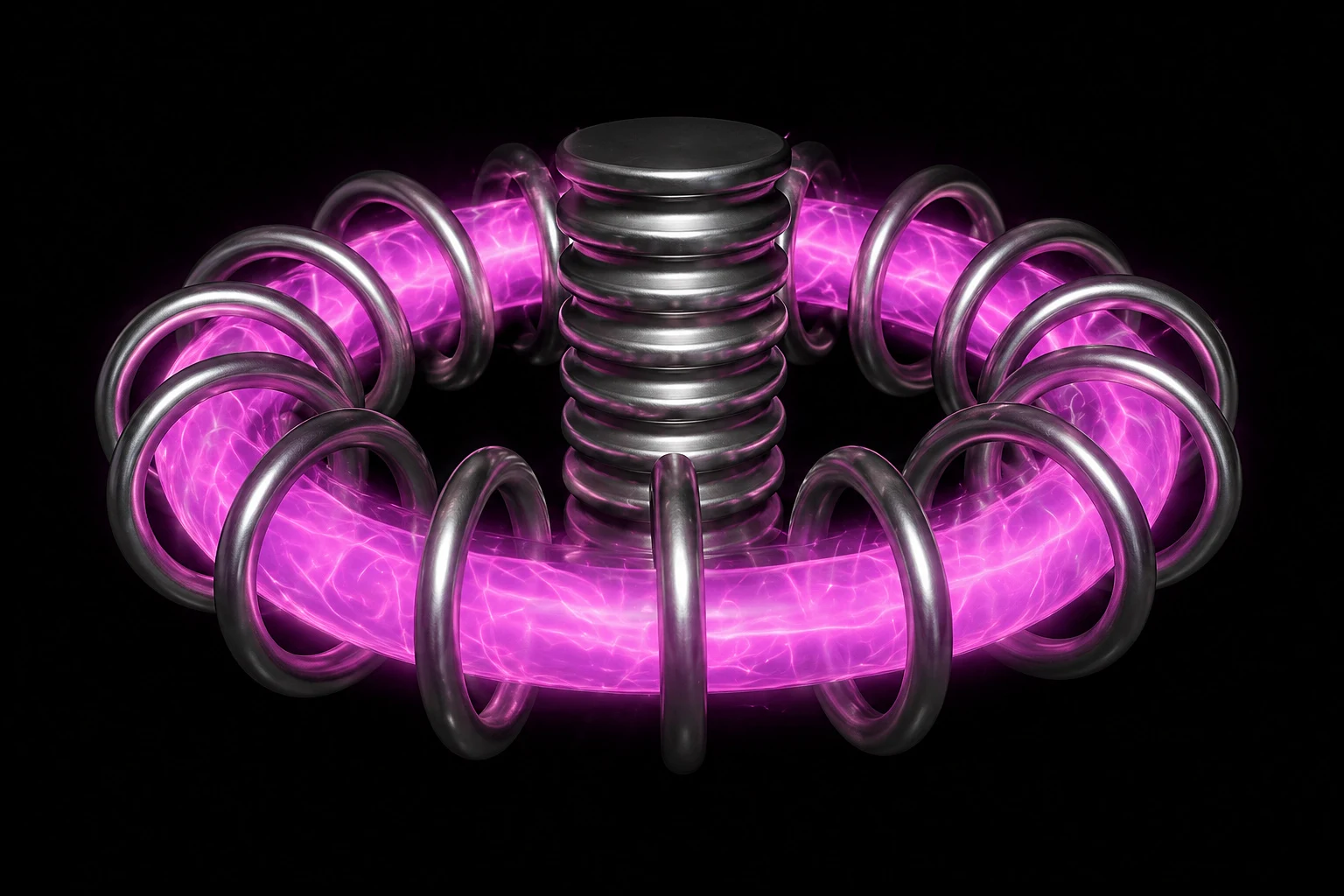
A ring-shaped (toroidal) plasma (company illustration, American Fusion website). Test results are as reported by the company; they are not independent validation.

Pulsed, compact and modular by design.

The plan

Sell the power,

not just the machine

American Fusion's model is to own and run Texatron units, at a customer's site or on the grid, and sell the electricity under long-term agreements. Its deck also lists equipment sales, leases and licensing.

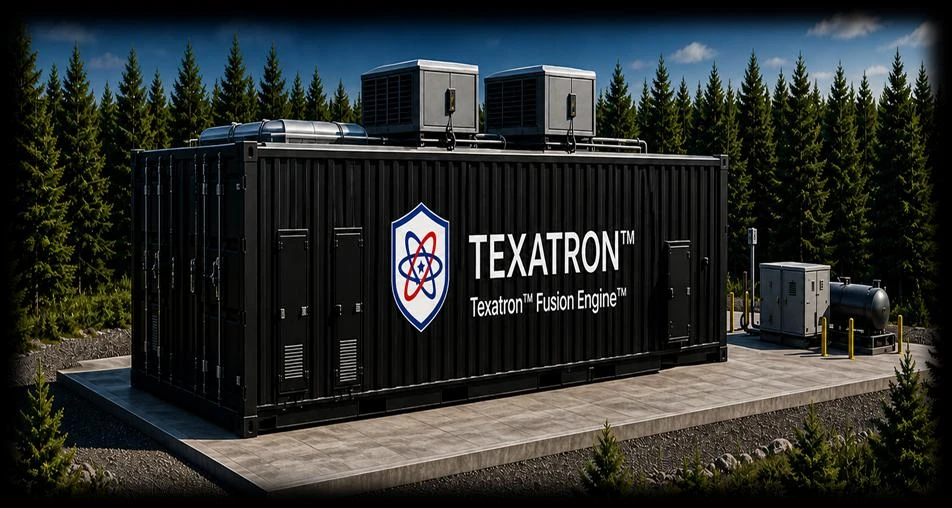
A planned Texatron™ Fusion Engine unit on site (company rendering, Q4 2026 investor presentation)Data centers

Texas · Power-as-a-Service

A data center needs its own steady power, close to where it is used.

Owner
American Fusion owns and runs the unit.
Contract
The customer buys power long term.
Site
Behind or in front of the meter.

Four proposals had been delivered and were in discussion as of October 13, 2026, and proposals for at least four more Texas data center projects were being prepared. No definitive agreement has been announced.

Where it stands

  • One letter of intent sent; the company has not said whether it relates to one of the four proposals (Oct 2026).
  • Five more developers identified as prospects, with talks under way with four of them (Oct 2026).
  • Conditions: any deal depends on technology validation, financing, regulatory requirements and definitive agreements.

Planned range · Q4 2026 investor presentation

One family of engines, from emergency power to the grid.

Micro
0.5–2.0 MW for emergency and off-grid power.
Modular
20–50 MW for data centers and microgrids.
Grid scale
250 MW+ for regional utility grids.

Standard units are designed to run alone or together, so capacity can be matched to a site and grow with it. These are planned sizes; none has been built or demonstrated at these ratings.

Also in the plan

  • Mobile, 5–20 MW: industrial and construction sites, remote military field operations and disaster response.
  • Utility class, 100 MW: hyperscale and AI data centers and chip plants.
Why now

Four trends

behind the plan

Demand

Data centers need power

ERCOT reported in April that it was tracking about 410 GW of proposed large loads in Texas, about 87% of them data centers (cited by the company, Aug 2026).

Speed

Time to power

The company believes that how fast a large user can get power, not just its price, is becoming a deciding question.

Capital

Money is flowing to fusion

The Fusion Industry Association reports 56 fusion companies raised about $4.48 billion in the 12 months to July 2026 (cited by the company).

Policy

Governments back fusion

Nearly $1.6 billion has been enacted for the U.S. DOE's Fusion Energy Sciences in fiscal 2025–2026 (company deck, citing the DOE).

The patents

Protecting

a family of engines

American Fusion files patent applications on the core design and on alternative chambers, materials, fuel injection, coils and pulse controls, aiming to cover many sizes and future generations of the Texatron.

151

U.S. patent applications pending as of September 22, 2026.

260+

Applications the company aims to have filed by the end of 2026 (a company objective).

Pending U.S. patent applications

As reported by the company, 2026

Aug 2417 new filings
100
Sep 830 new filings
130
Sep 2221 new filings
151

Patent applications are subject to examination by the U.S. Patent and Trademark Office; there is no assurance that any will be issued as a patent.

Catalysts

What to watch

Coming up

Recent announcements and the company's own targets. None is assured, so watch for news releases confirming each one.

  1. Now · November 2026
    • Independent review: final report expected before the end of November, subject to completion of the review; not released as of November 26Pending
    • Ranch Facility: closing was expected before November 26 (earlier, by the end of October), subject to closing requirements; no closing announced as of November 26Not announced
    • New facility: factory and office leases expected to begin in NovemberExpected
    • Series D exchange: proposed swap of consulting notes for preferred shares, subject to definitive agreementsProposed
  2. Next

    • Texas Tech: preparing to resume bunker testing, and evaluating other test sitesPlanned
    • Data center proposals: at least four more being prepared for Texas projectsIn progress
    • Financing: investment bank proposals under negotiation; no definitive engagementNegotiating
    • Technical manuscript: to be made public after review and publicationPending
  3. By end of 2026

    • 260+ patent applications, the company's filing objectiveTarget
  4. Later

    • National exchange listing: Texas Stock Exchange preferred (Sep 2026), Nasdaq and NYSE also evaluated; no venue selected; may require a reverse stock split to meet bid-price rulesTarget
The difference

The Texatron

A different route to fusion

Conventional approaches

  • Steady hot plasma
  • Big fixed magnets
  • D–T fuel, more neutrons
  • Steam and a turbine

As the company describes them

Texatron

  • Short pulses
  • Pulsed compression
  • Helium-3 fuel
  • Direct conversion

Each still to be proven in testing

Fewer neutrons

D–³He fusion releases most of its energy in charged particles, which the company says means less radiation damage to equipment and reduced shielding.

Skip the turbine

Thermal power plants top out around 40% efficiency; the company says direct conversion could in theory exceed 90%. It has not been demonstrated.

Helium-3 is rare

The company notes helium-3 comes from limited natural reserves or as a by-product of nuclear processes.

We welcome independent scrutiny of our Texatron™ technology and our engineering program. Our objective is to demonstrate our progress through a disciplined process of technical evaluation, testing and independent assessment.
Brent Nelson · Chairman and CEO, American Fusion · Nov 9, 2026
Company contact

Talk to the company

Read American Fusion's SEC filings and latest news on the company website before making any decision.

Chairman and CEO
Brent Nelson
Phone
+1 833 872 2636
Office
401 N Carroll Ave., Ste. 192 Southlake, TX 76092
Ticker
OTCQB: AMFN

This profile was prepared from American Fusion Inc.'s investor presentation dated Q4 2026 (published November 2026), its website, its news releases to November 13, 2026, and its Quarterly Report on Form 10-Q for the quarter ended September 30, 2026 and Current Report on Form 8-K of October 30, 2026 and Form 8-K/A of October 22, 2026. It is for information only and is not an offer to sell or a solicitation to buy securities. It contains forward-looking statements, including target dates, planned facilities, financing, listing plans, commercial proposals and technology goals, that involve risks and uncertainties; actual results may differ materially. The Texatron™ is under development: fusion ignition, net energy gain, direct conversion of fusion energy into electricity and commercial power generation have not been demonstrated. Test results are as reported by the company and are not independent validation; fusion energy figures in company releases are calculations, not measurements. The Texas registration authorizes research and development only and is not certification of the technology. Planned unit sizes have not been built or demonstrated. Patent applications are not issued patents. No definitive commercial agreement has been announced. Market and policy figures are cited by the company from third parties and have not been independently verified. The company's Q3 2026 10-Q reports substantial doubt about its ability to continue as a going concern. Pictures are company renderings and illustrations, not photographs of built equipment. American Fusion Inc. is a paid client of AGORACOM; see the hub disclaimer for compensation details. Do your own research and review the company's SEC filings before investing.

Management

  • Brent Nelson

    Chief Executive Officer

    CEO of Kepler Fusion™ Technologies and a key driver behind the Texatron™ commercialization strategy. Nelson focuses on execution, system deployment, and scaling fusion into real-world infrastructure applications.

  • Richard C. Hawkins

    Chief Administrative Officer (appointment subject to acceptance)

    A strategic executive focused on building scalable energy platforms, capital markets execution, and corporate transformation. Hawkins has led the transition from Renewal Fuels into American Fusion™, aligning the company around a unified vision of commercial fusion deployment.

  • Michael Smith

    Corporate Secretary

    He has extensive experience adapting to new challenges in technology and law and has supervised highly successful teams in software development and legal representation. He was the Tech-team leader of the 4th online banking system in the world, Bank One, 1996-1998. Michael also has U.S. Supreme Court Experience: Co-counsel in Ali v. Federal Bureau of Prisons (No. 06-9130, 2008).

  • Michael Carlson

    Chief Financial Officer

    Mr. Carlson brings extensive governance experience, including service on boards and supervisory bodies, and is currently a member of the Board of Trustees of the American International School of Budapest. As CFO, Mr. Carlson will lead the Company’s financial strategy, capital markets initiatives, financial reporting, and institutional engagement as it advances its development and commercialization efforts.

  • Dewight Cartwright

    Chief Operating Officer

    Since joining Kepler Fusion™ Technologies in 2018, Mr. Cartwright has spearheaded the operational execution of the Texatron™ aneutronic fusion reactor. His extensive portfolio includes managing critical projects for the U.S. Army, the Army Corps of Engineers, and various major municipal water authorities.

  • Dr. John E. Brandenburg

    Chief Technology Officer

    A veteran plasma physicist with more than 40 years of experience in fusion energy and advanced propulsion. As CTO, he leads reactor physics, technology strategy, and the continued development of the Texatron ™ platform.

  • Dr. Robert V. Duncan

    Independent Scientific and Strategic Advisor

    Dr. Duncan’s experience spans fundamental physics research, national laboratory leadership, intellectual property development, technology commercialization, and federal scientific advisory roles. The Company believes his experience and independent perspective will provide valuable guidance as American Fusion™ advances development and testing of the Texatron™ Fusion Engine™ platform.

  • Travis Yakimishyn

    Chief Electrical & Power Systems Officer

    Mr. Yakimishyn currently holds senior leadership responsibilities within BC Hydro, one of North America’s largest regulated electric utilities, where he manages province-wide transmission and distribution programs totaling approximately $20 million annually. He played a central role in defining and advancing the electrical power system architecture for the Texatron™ platform.

Disclosure

American Fusion Is Building The Power Layer For The AI Era. Read the full disclaimer