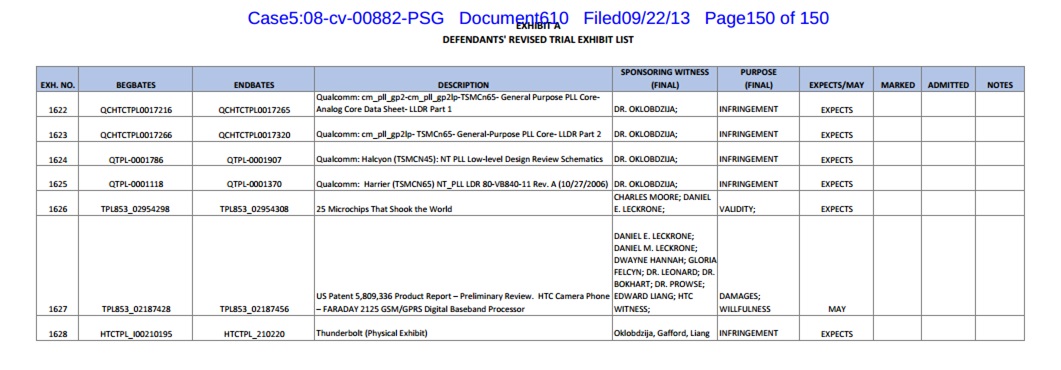
It looks like we don't want to confuse the issues for the jury by including "variable speed" etc, and want to focus on "entire oscillator," which I believe makes it easier for TPL and PATRIOT to focus on the ring oscillator as being the clock generator without bringing in "variable verbiage," etc. As a juror I believe it is easier to believe the ring oscillator is the "entire oscillator" than the ring oscillator being the "entire variable speed system clock" with all the componets of a PLL and the external clock that all play a part. I'm hoping this is over in three days. As BaNoss said, and I will state a bit differently, did the ITC ID provide the legal backing HTC used to help eliminate thr other claims? I believe due to the court's ruling we are only focusing on the "entire oscillator," and since HTC is not going to pursue invalidity, we will not be able to introduce the 25 Micrprocessors that Shook the World article from the IEEE magazine. Now we will focus on 100+ licenses, how the ring oscillator is the "entire oscillator" because it runs freely when the system starts and then it gets narrowed into a range. We will also focus on how process and temperature affect the speed of the ring oscillator. Should be enough. We will see this week hopefully.
Am posting from my phone as cable service went down an hour or so ago, so this probably won't format correctly.
I hate to lose the IEEE article, as its credibility is great evidence for laymen. Any chance there is some mention of the clock or RO in there?
Also, with validity no longer at issue, I question the evidentiary value of 100+ settlements. That part is great, but our opponents would undoubtedly then introduce the nuisance value nature of them.
Will post later if cable service restored.
What a strange and silly thing to say. I'm not sure why you would pick out only my post in this context, since other members here have been talking at length about technical issues that could be just as insightful, if not more so, to our opponents. Of course, the truth of the matter is that these lawyers know all about this stuff without us saying anything about it --- if they didn't, they'd be idiots, because, to other attorneys, the things I've mentioned are pretty basic. I seriously doubt that they read this board, but even if they do, I think it's even less likely that they get any "pointers" from what we say here.
This is the second time within just a few days that you have seemingly felt a need to be critical of my efforts in this forum. Perhaps it would be best if you simply stop reading my posts. I've done that with several members here and it works really well. Just a thought. Thanks.
Correct! I pray Jim Otteson is already ahead of us understanding the arguments rather than still trying to get tips from us. Otherwise we are truly doomed.
I never post tech opinions, because it's a foreign language to me.................This is why your good deeds here are priceless..........Your posts are not biased, and like great reporters, it's just the facts .......EXCITED that we are entering the prize fight, and that first round bell is about to be rung...........The best to all the loyal shareholders........
The IEEE article is below. Doesn't refer to the ring oscillator but gets to the spirit of the invention. <<<<>>>> Computer Cowboys Sh-Boom Processor (1988)
Two chip designers walk into a bar. They are Russell H. Fish III and Chuck H. Moore, and the bar is called Sh-Boom. No, this is not the beginning of a joke. It’s actually part of a technology tale filled with discord and lawsuits, lots of lawsuits. It all started in 1988 when Fish and Moore created a bizarre processor called Sh-Boom. The chip was so streamlined it could run faster than the clock on the circuit board that drove the rest of the computer. So the two designers found a way to have the processor run its own superfast internal clock while still staying synchronized with the rest of the computer. Sh-Boom was never a commercial success, and after patenting its innovative parts, Moore and Fish moved on. Fish later sold his patent rights to a Carlsbad, Calif.–based firm, Patriot Scientific, which remained a profitless speck of a company until its executives had a revelation: In the years since Sh-Boom’s invention, the speed of processors had by far surpassed that of motherboards, and so practically every maker of computers and consumer electronics wound up using a solution just like the one Fish and Moore had patented. Ka-ching! Patriot fired a barrage of lawsuits against U.S. and Japanese companies. Whether these companies’ chips depend on the Sh-Boom ideas is a matter of controversy. But since 2006, Patriot and Moore have reaped over US $125 million in licensing fees from Intel, AMD, Sony, Olympus, and others. As for the name Sh-Boom, Moore, now at IntellaSys, in Cupertino, Calif., says: “It supposedly derived from the name of a bar where Fish and I drank bourbon and scribbled on napkins. There’s little truth in that. But I did like the name he suggested.”
"the 25 Micrprocessors that Shook the World article from the IEEE magazine"
Reference to the article could be presented to the jurors ears in the opening or closing statement. Not considered evidence, but maybe something they should hear.
Yes they can, in the opening and closing statements. Jury is instructed that opening and closing statements aren't evidence, but it can be said. Read page 9-10 Civil Minute order. Outline of trial.
I understand that and I read as much. You can refer to anything that has not already been decided by the judge. What is the point of precluding a jury from hearing about the ITC ID evidence in an order when you can simply delve into the detail of how an ALJ at the ITC ruled the way he did in opening and closing remarks? I could go on and on. If I'm wrong so be it but it doesn't make any sense to allow the attorneys to simply use opening and closing statements to introduce de facto evidence. It becomes persuasive and prejudicial to TPL/PTSC if HTC can remark upon Judge Gildea's ID. What is the point of excluding it then ?
I would hope that Otteson would point out that due to the overly drawn out nature of this litigation (5yrs!) that the most recent licensing agreements had to be on the lower end so as to fund this litigation and just keep the lights on for PTSC's public shareholders.. all the while eating up multiple yrs of licensing which potentially could have yielded more 'HP-type' fees.. 'PTSC shareholders (and therefore the 'little guy') have been the real losers here'...
You are correct. Under Purpose column, it says Validity. Since the Validity is no longer an issue, our side may not be able to show it to juries.
Why our side did not also include "INFRINGEMENT" under the Purpose column. "In the years since Sh-Boom’s invention, the speed of processors had by far surpassed that of motherboards, and so practically every maker of computers and consumer electronics wound up using a solution just like the one Fish and Moore had patented." After seeing this part again from the layman's point, I'm kind of lost.
I'll explain this quickly, each side were given 5 high priority objections about a 1 month ago. The IEEE article was part of the order by the judge. If HTC does not go after invalidity, PTSC can't use the article, unless some deal was made. I don't think it will be allowed.