Skip to content
Sign in

Post

POET Technologies Inc.

You’re reading rainer’s reply in this thread.Jump to it

Treasurer2.4 rating from 136 members3.5K ptsRate

TFSA Transfer in kind ----- IMPORTANT

I just transfered 2848 shares from Cash to TFSA at TD

You can chose high or low or close price for yesterday I chose low of course which was 1.58

Broker transferred immediately.

It takes 24 hours to show up he said.

Join the conversation about POET Technologies Inc.

Reply

Replies

          1. With TD if you did a transfer between market close and midnite last nite you can chose any price you want between the high and low of the day.

            If you do a transfer between midnight and market open today you have to use the close of $1.62 (which is what I did).

            TD called me back about half an hour later and told me that this TFSA increase is not offical yet and I may get caught with over contribution. Wanted to know if I wanted to cancel my trades. I left it as is.

        1. tj> they told me i cannot buy until the market opens.

          {disclaimer: I am not a securities lawyer}

          if you're opening a new position, then yes that makes complete sense, 100%.

          however, if it's a transfer of existing position, and the economic/beneficial owner is the same, it's NOT a buy/sell, in fact it seems to be FORBIDDEN to be processed as a buy/sell.

          my understanding of UMIR 2.2 is that the txn MUST NOT hit the market

          "required to be executed off-marketplace" seems to indicate there is no choice

          (i.e., it's not up to the brokerage's policy/whim as to how the txn gets processed)

          see page 5 and into page 6 of http://www.iiroc.ca/industry/rulebook/Documents/UMIR0202_en.pdf

          for example ...

          “a client executing a trade [...] would not constitute a change in economic ownership and would be required to be executed off-marketplace."

          you would have to account to CRA for a "deemed disposition" but that's about it.

          jimbo might be able to confirm.

          GLAL,

          R.


          1. Absolutely a deemed disposition from an "open" account to a "registered" or "sheltered" account. No different than transferring stock into your rrsp "in kind".

            You don't want to transfer any shares in that are in a loss position, if you bought at a higher cost basis, as that loss is denied.

            Jimbo

              1. Replying to @fahrenheit451

                Intel's 10nm Secrets Predicted

                http://www.eetimes.com/document.asp?doc_id=1326410


                Quantum well FETs, germanium, InGaAs in mix

                SAN JOSE, Calif. – A semiconductor analyst is making a bold and detailed prediction about the process technology Intel Corp. will use for its next two generations. If he is right, the world’s largest chip maker is set to leapfrog the industry once again.

                Intel will use quantum well FETs starting with its 10nm process, said David Kanter in an analysis posted on his Real World Technologies Web site. The new transistor structures will use two new materials – indium gallium arsenide (InGaAs) for n-type transistors and strained germanium for p-type devices, he said.

                If correct, Intel could gain a capability as early as 2016 to produce 10nm transistors as much as 200 millivolts lower in power consumption than the rest of the industry. Kanter expects other chip makers will not be able to catch up with the techniques until their 7nm node, at least two years later.

                It could take more than a year before Intel discloses its 10nm plans, Kanter said, giving his own predictions an 80-90 percent confidence level.

                Kanter’s analysis is based on a study of about two dozen Intel research papers mainly presented at the annual International Electron Devices Meeting (IEDM), a leading gathering of chip makers. He also analyzed as many Intel patents related to chip making.

                “Everything I saw pointed in this direction,” Kanter told EE Times. “The question is not will Intel do quantum well FETs, the question is will it be at 10 or 7nm,” he said.

                “Using compound semiconductors in the channel is not unique to Intel’s research, but it’s clear no one is quite so far along as Intel publishing on them,” Kanter added. “Intel’s papers and patents on germanium were more scarce, but that technology is more well understood,” he said, noting he expects Intel to adopt pure germanium although it may progress via a half step to silicon germanium.

                Kanter provided Intel a look at his article before it was published. The chip make declined to comment on it.


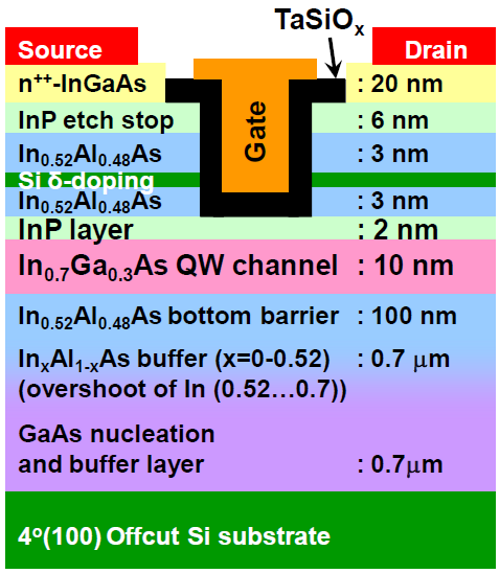
                Intel showed work with InGaAs in this image from a 2009 IEDM paper.

                1. Replying to @phil-v

                  I have been asked by one of you forum members for my opinion about David Kanter's prediction regarding Intel's plan for 10 nm or even 7 nm.

                  Okay, so why not answer in public! Did I sell my POET shares? No! Did I buy more? Well, not today, but recently.

                  Without going too much into technical details, there are some obvious similarities between Intel's image from 2009 and POET's work, namely the use of GaAs – though not as a substrate, but as a "nucleation and buffer layer", as Intel puts it. Other common terms we recognize are "strained InGaAs" or "quantum well". There is, however, a remarkable difference in that Kanter assumes InGaAs for the n-channel and SiGe for the p-channel, while POET uses InGaAs for both.

                  Aside: If you want to dive deeper into the technical details (or at least into some of them), you should read "GaAs: The logical successor to CMOS" and "Moore's Law Has No End in Sight". Make sure you also read the comment section of the latter as it has a comment from someone at POET Technologies, cited by the article's author R. Colin Johnson. End aside

                  Generally speaking, competition never sleeps, will it? If Intel is really going to deploy III/V materials in their upcoming technologies, this would not only be competition in some areas, but it would also be a nice confirmation of POET's approach.

                  However, please keep in mind that Kanter's prediction is not necessarily Intel's roadmap, but rather just, well, a prediction.

                  We'll have to wait and see …

                  • whether this is indeed the way Intel's will go forward,
                  • how fast they will be able to proceed, especially if they are targeting 10 or 7 nm,
                  • whether and how they will have to circumvent Dr. Taylor's patents,
                  • whether they'll have to license POET's IP,
                  • whether they will go for 10 or 7 nm with their extreme costs.

                  The most prominent difference, however, is that Kanter's prediction is all about transistors. No thyristors, no optics, no integration of optics and electronics, no analog, no mixed-signal. Much less than what POET is offering!

                  Now let's assume for a moment that everything plays out fine for Intel and that they'll have a fast GaAs chip technology in 10 or 7 nm. Would be great if they'd have to use POET's IP! But what if not? Bye, bye, POET's monopoly in the integrated electronics area!

                  On the plus side Intel's competitors would be under pressure to come up with an alternative. And yes, there'd be something we could recommend …

                  A lot would still be left over, see above. I believe we cannot overestimate the relevance of the optoelectronical integration. For example, have a look at the transcript of the CIC video and have Stephane Gagnon explain that to you, starting at 12:21 and especially from 14:04!

                  Oh, and then there's the question of different target node sizes, but this post is already long enough, so I'll leave that for someone else who might want to jump in here.

                  1. Replying to @rainer

                    Thanks for this post Rainer.

                    As i can see, for the P channel they could use Germanium or III-V materials.

                    1. The industry will adopt strained Germanium (most likely) or III-V materials (as an alternative) for the p-type QWFET channel.

                    It is always very informative to reed your posts. You are an essential poster for this board.

                  2. Replying to @rainer

                    Thank you so much for your post clairifying the Intel approach to overcoming the weakness of continuing with Silicon and switching to the III-V materials at the smaller nodes. I would think ( hope) they would just license the III-V IP from us. As you pointed out, they are aiming for the electronics side of the chips, but I believe the optics/photonics part is the real end game at this point. I believe we (Geoff) are way ahead of them, having adopted and developed these materials long ago. The Quantum aspec is very intriguing but I think it will take more time to develope. Intel will only drive customers to us if they go it alone (another point you touched on). It seems the term "collaborate" rings true more and more. Hopefully their management will see collaboration as the most sensible and profitable avenue to proceed, I would think their stockholders would. In any case, kind of important to first to the market, and use the old "leapfrog" approach in advancement.

                  3. Replying to @rainer

                    what's interesting is that Intel's QWFET research cites Geoff's already-accomplished work*.

                    that interlinkage is just one example, there are many others with Taylor as predecessor ... probably too many to easily list.

                    just because he's tucked away happily being an egghead at UConn (instead of being owned by suits in Silly Valley), and he's funded by a tiny Canadian venture (instead of VC sharks or the entrenched behomoths and their marketing mouthpieces), people tend to forget that Taylor is the world-leading authority on III-V materials physics.

                    he went there, and did that, while they were still in diapers.

                    GLAL,

                    R.

                    * and that of Cai and Yao and Opper and Cooke and Kiely and ... well, the entire POET lab team, really.

                  4. Replying to @rainer

                    Rainer,

                    Thank you so much for your excellent response to Kanter's predictions of Intel Plans. Your response is why people read this board.

                    If I may add some comments:

                    On the assumption that Intel were indeed developing lll-V based products. I would imagine that other big names might see early adoption of POET as the only possible response.

                    Focus on PET tends to cloud the fact that the 'O' in POET is what Dr Taylor is about. I think when he said all roads lead to POET his assessment is that his IP is unique in this respect and others will have to adopt his IP.

                    Again thanks for your excellent analysis.

                    Sula

                  5. Replying to @rainer

                    Thank you all for commending me on my "Intel plans" analysis! You are welcome!

                    Some of you seem to assume that these are Intel plans in reality. However, we can't be sure about that. We don't know what Intel is actually planning – stealth mode, you know.

                    The text we are discussing are just predictions made by David Kanter. I would call them educated guesses. These predictions may or may not be true. Or some aspects are true and others are not. We cannot be sure.

                    Oh, and by the way, our "good old friend" Joel Hruska showed up in the discussion section, ranting about "POET trolls". Medical advice from a non-medic: Don't read if you are suffering from high blood pressure!

                    1. Replying to @rainer

                      Rainer , so Joel H is a troll on our board. How would he know about medical advice? He has time to troll but not to confirm poets advancement.
                    2. Replying to @rainer

                      rk> by the way, our "good old friend" Joel Hruska showed up in the discussion section, ranting about "POET trolls".

                      I've got this one.

                      it appears that the original poster that set JH off was curious about the science, and made no mention of the company (Hruska's the one trolling, if not stalking).

                      hopefully Kanter will see that, and moderate him into oblivion.

                      don't get baited into Joel's trap -- it's a good idea to keep promotion entirely out of that thread (else his trolling become prophesy).

                      better to sit back at this point and give Kanter and his audience the floor to respond.

                      GLAL,

                      R.

                    3. Replying to @rainer

                      "Oh, and by the way, our "good old friend" Joel Hruska showed up in the discussion section, ranting about "POET trolls". Medical advice from a non-medic: Don't read if you are suffering from high blood pressure!

                      That guy just wont give it a rest...............always remember this people, the greater the technology, the greater the doubt......at least in the eyes of the public....our time is near

                      1. Replying to @ZL1

                        As early as February 23 Intel announced its plans to move in thirds direction. The article is even posted on the poet website under industry articles. We should not be so surprised if we are doing our due diligence.
                        1. Replying to @Omcgoodness

                          IMO, Intel announcing the possibility of "thirds" as you say, in their future plans is a positive for Poet and hence the reason that first article is on the Poet Website. Basically Intel going public with this information helps us, if Intel is backing this technology the market will be much more receptive to our claims going forward.