Skip to content
Sign in

Post

POET Technologies Inc.

You’re reading shoeshineman’s reply in this thread.Jump to it

Prez3.6 rating from 53 members2.6K ptsRate

Sample testing

I'm unsure if it was posted on here or elsewhere, but I feel like I have read in multiple locations that sample testing requirements of 5000hours will be met this month. That is not true. Samples were sent out 3/20/25 according to POET. Delivery and installation of these items would take at LEAST 1 week, possibly up to 2 or 3. If we do the math - 5000 hours/24 hours = ~210 days. 210days from 3/20 is October 16th. Assuming we need 2 weeks for shipping, receiving, and installation, that would put POET and customers on track to complete 5000hour testing requirements by ~Nov. 1st.


We know that timelines can be expedited, but not by how much, nor do we know if POET would fall into this category. Being a very new technology, I would say that there is an above average chance that customers want to validate with the most rigorous of standards if they want to move forwaed with this new platform technology. You can't shift your supply chain on promises, you have to be 100% certain these things will work before you begin to spend your entire supply chain to pivot to this new technology.


It's really hard to be patient sometimes...

Join the conversation about POET Technologies Inc.

Reply

Replies

  1. What is important to understand is that POET is using known good die. The optical and electronic chips from their suppliers have either all been commercially deployed or have previously been qualified otherwise POET would not use these devices in their finished products. The optical interposer has long since been qualified under higher than normal stress conditions to ensure it stands up to the required aging limits. So in my opinion there could well be a level of risk tolerance to accept these products early. No one is going to bet farm until they have been used in a live sandbox environment and they should know very quickly whether they meet live system requirements. Also given that we are talking about pluggables any failures can be swapped out.  


    I was told years ago that they pushed the stress testing limits on the Optical Interposer early before moving into the advanced optical engine designs. We are seeing designs which are now using the same modules which reduces design costs and qualification cycles.


    Also with a limited supply available until production ramps I expect there will be those that want to gain access early so that they can secure their needs when volume production becomes available. It just makes sense that these industry leaders move on their supply needs and assume a level of risk tolerance that is limited as opposed to waiting and losing their position in the lineup. Also I would guess that there would be some incentive pricing for the early adaptors.


    1. Good points.  I believe we are already in the zone for receiving purchase orders at any time, and that initial POs may be smaller quantities at first.  Such is the nature of a production ramp.  A datacenter may put a rack or small number in place before committing to a larger order later.


      Related to NTT, unlike Mitsubishi, this news release was timed when tech stocks were pulling back and ahead of a holiday weekend (poor timing).  And as tech stocks recovered we did not get the love and recognition.  That does not mean that the NTT deal was not big news.  The potential in this space for 5G and 6G rollouts is in the millions of units and by nature comes with a NTT as a guaranteed customer:


      Perhaps that is based on timeline (2027).  Perhaps it is based on the fact many missed the news, and it was no longer a tradeable event.  But for the institutional investors following poet, for the institutional investors knowing we entered a new addressable market with a guaranteed customer that buffers us from purely datacenter build-out and lowers risk, this will not go unnoticed. 


      It makes us a better value play.  It puts a huge customer in our pipeline to be included in our revenue ramp.  The odds of a successful revenue ramp has increased significantly because of NTT, and the risk of a slowdown in the datacenter build-out is reduced.  They are yet another huge IT customer, and a relationship that can grow.  It is amazing and impressive how we are doing in Japan-something that may not have occurred had we not pivoted to Malaysia. 


      We are just going to have to accept this news was not yet trade-able news in the short run, but for the patient it may yield a bigger payoff down the road, and with other Telecom customers, and among our existing customers.  Yes, the following was gleened using AI...


      For example:

      Adtran: Strong Presence in Fronthaul. Adtran has launched the AccessWave50, a C-band tunable 50 Gbps transceiver specifically designed for 5G fronthaul deployments. It supports 50G Ethernet and eCPRI, making it ideal for mobile network operators upgrading fronthaul capacity. Features like auto-tuning, zero-touch provisioning, and G.metro spectrum efficiency position Adtran as a key player in next-gen fronthaul infrastructure


      Luxshare ICT:  Active in Fronthaul Components Luxshare ICT manufactures base station antennas, wave filters, and remote radio units (RRUs)—all critical components of the 5G fronthaul layer. Their portfolio includes optical modules, high-speed interconnects, and thermal management systems used in wireless communication infrastructure.


      Yes, Mitsubishi Electric is involved in both datacom and telecom, though its role is more nuanced compared to companies that focus solely on networking hardware.


      Closest competing products:


      While no other company currently offers a 100G bidirectional optical engine specifically for fronthaul, several alternatives exist in the broader 100G optical module space: These alternatives are widely used in data centers, metro networks, and backhaul, but they lack the bidirectional efficiency and fronthaul-specific tuning that POET and NTT are targeting.


      QSFP 100G BIDI DR; FS.com, Asterfusion; 100G over MMF using two wavelengths; ideal for short-range datacenter links


      QSFP 100G CWDM4; Coherent, Lumentum; 100G over SMF using 4 wavelengths; up to 2 km range; used in metro and access networks


      QSFP 100G LR4; II-VI, Innolight; 100G over SMF up to 10 km; used in long-range telecom and datacenter backhaul


      QSFP 100G FR/DR/DR4; Broadcom, Intel; PAM4 modulation; 100G over SMF for short to medium distances, common in hyperscale deployments.


      These alternatives are widely used in data centers, metro networks, and backhaul, but they lack the bidirectional efficiency and fronthaul-specific tuning that POET and NTT are targeting.


      Strategic Advantage with NTT: NTT is not just a development partner—it’s also expected to be a guaranteed customer, using the engine internally and potentially distributing it to other telecom operators. This partnership gives POET direct access to Japan’s mobile infrastructure market, which is aggressively investing in low-latency, high-bandwidth fronthaul for AI and edge computing.


      Deployment Potential Given the projected market size and NTT’s scale, the volume potential could reach millions of units annually once 5G densification and 6G rollouts accelerate. The engine’s fourfold bandwidth efficiency and single-fiber bidirectional design make it especially attractive for operators looking to reduce fiber costs and simplify deployments.



    2. Fairchij: What is important to understand is that POET is using known good die. The optical and electronic chips from their suppliers have either all been commercially deployed or have previously been qualified otherwise POET would not use these devices in their finished products. The optical interposer has long since been qualified under higher than normal stress conditions to ensure it stands up to the required aging limits.


      I don’t really think anybody is lowering the test requirements here. Using known good die and a thoroughly stressed Optical Interposer certainly reduces risk. But once you bring everything together in a new optical engine, integration is still the real test.


      Coming from a software background, I can’t help but think of it like unit tests vs. integration tests. All the components can look great on their own, and yet the system test still has a way of uncovering surprises.


      What does get shorter is the lead-up: customers don’t need to repeat the component testing that POET, its suppliers, and likely they themselves already did. They can move straight to their own system/integration tests. But those tests themselves still take the usual time – you can’t cut corners there.


      Some POET customers might still want to get their hands on POET’s modules early, knowing they might uncover an issue or two along the way. That’s not about cutting corners, it’s the normal trade-off between time to market and exhaustive qualification. The real advantage is that pluggables make it easier: if something fails, you swap it out.


      And one more point: for customers it really comes down to balancing two risks. On the one hand, if they spend too long on testing, they could lose their place in line and face shortages when production capacity gets fully booked. On the other hand, if they cut testing short, they may miss flaws that become very costly once thousands of modules are in the field.


      The real challenge is to hit the sweet spot: enough system validation to be confident in performance, but fast enough to secure the volumes they need when ramp-up happens. And that “sweet spot” won’t look the same for every module maker — a large, well-established player may take more time to protect its brand reputation, while a smaller competitor might accept higher risk just to secure early capacity.

      1. This is the Rainer style of explaining  , which we know from the times, when we co- financed his AGM trip. Thx. Very helpful perspective.

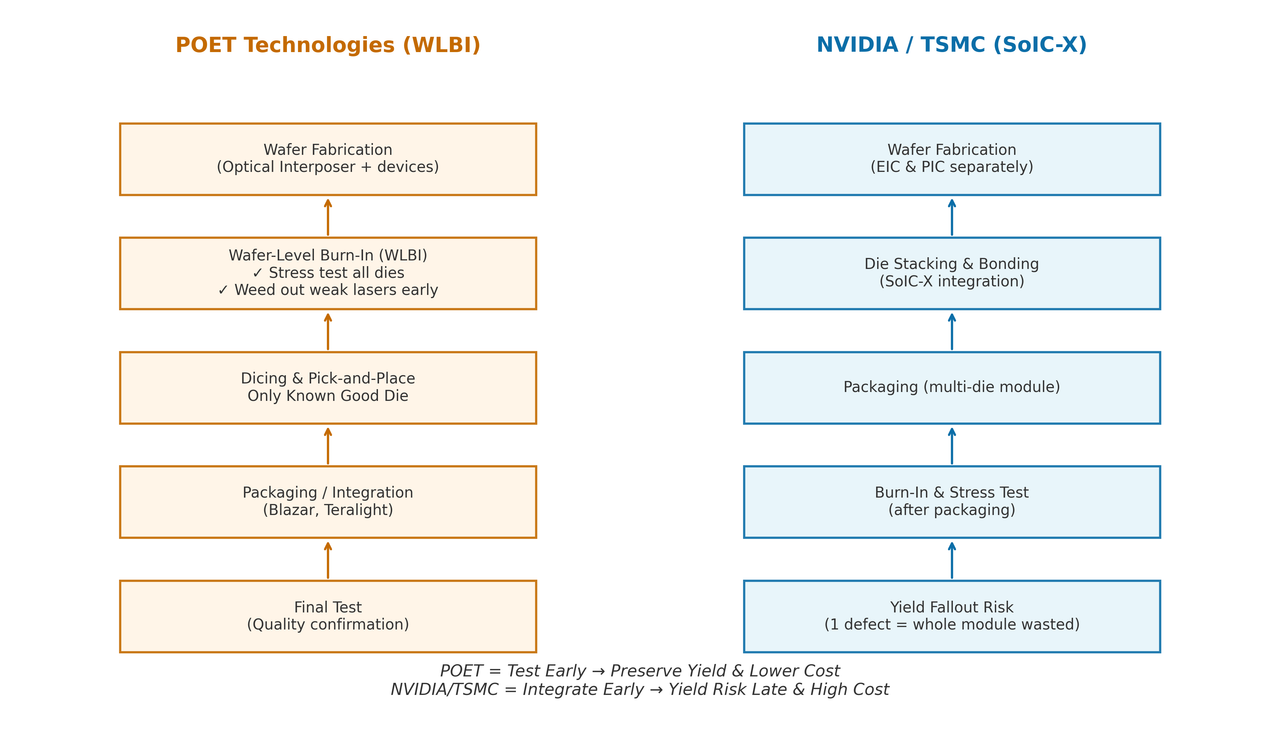
      2. Fortunately POET performs wafer level burn-in testing as per https://www.poet-technologies.com/videos The test probes described in patents seem to be limited to as I recall 4 or 8 test points per engine. So the example provided does not give a one to one comparison.


        wafer level burn in
        Wafer-level burn-in (WLBI) is 
        a semiconductor testing process that applies accelerated electrical stress and high temperatures to integrated circuits (ICs) while they are still on the wafer. This process identifies and eliminates potential early-life failures (often called "infant mortality") before the die are separated, packaged, and shipped. 

        The Technology of Semiconductor Wafer Level Burn-In: A ...
        Wafer Level Burn in - 4JMSolutions
        Wafer Level Burn In & Test - Semicionductor Testing
        Wafer Level Test & Burn-in - Aehr Test Systems | Solutions
        Wafer-level Test and Burn-in [WLTBI] market 2025-2034 | Size ...
        By conducting the burn-in phase earlier in the manufacturing process, companies can significantly improve product reliability, reduce overall costs, and streamline production flows. WLBI is especially critical for producing known-good die (KGD) and for advanced packaging technologies like multi-chip modules (MCMs) and system-in-package (SiP). 

        The WLBI process
        1. Preparation: The silicon wafer, containing hundreds or thousands of fabricated ICs (or dies), is cleaned and prepared for testing.
        2. Electrical and thermal stress: Specialized test equipment uses a wafer prober with thousands of needles to make electrical contact with the ICs on the wafer. The prober applies electrical signals to simulate operating conditions, while a heated chuck raises the wafer to elevated temperatures.
        3. Stress duration: The wafer is subjected to these accelerated conditions for a specified period, which can range from a few hours to a few days, depending on the device and testing requirements.
        4. Monitoring and data analysis: During the burn-in, the system monitors the ICs for electrical failures and performance degradation. Based on the collected data, defective ICs are identified.
        5. Sorting: Defective dies are marked with ink or a laser for removal before they can proceed to later manufacturing stages. 

        Benefits of wafer-level burn-in
        • Reduced manufacturing cost: By removing defective devices early in the production cycle, manufacturers avoid the cost of packaging and assembling faulty chips into more expensive components.
        • Enhanced product reliability: WLBI effectively screens out devices that would likely fail early in the field, which reduces customer returns and improves brand reputation.
        • High-volume efficiency: Performing burn-in on the entire wafer simultaneously is more efficient and faster than processing and testing individual packaged devices. This is particularly advantageous for high-volume products.
        • Enables advanced packaging: WLBI is essential for creating Known Good Die (KGD). For complex, multi-die packages like multi-chip modules (MCMs) and system-in-packages (SiP), it is critical to ensure that all die are reliable before assembly. 

        Challenges of wafer-level burn-in
        • Probe card complexity: Creating and maintaining an extremely dense array of probes that can reliably contact all the test pads on a wafer is a significant challenge. Precision alignment and ensuring consistent contact are crucial for accurate testing.
        • Thermal management: With thousands of ICs being stressed simultaneously, managing and dissipating the large amount of heat generated across the wafer is difficult. Hot spots or uneven heating can lead to inaccurate test results.
        • Test development costs: Specialized equipment and tooling are required, including the highly complex and expensive burn-in boards and contactors.
        • Device power variations: For complex chips like system-on-chips (SoCs), power consumption can vary significantly across the die during testing. Specialized techniques are needed to minimize this variation and ensure consistent and effective stress. 
  2. I have mentioned multiple times that September 20th marks the six month point.  It was gleened from other sources on the board that qualification generally takes six to nine months, so I am saying that the six month point at least puts us in the zone where a purchase order may come in, but I am not disputing your estimate that it may be several months out still yet, or in November.


    The March 20th news release states more generally that production orders are expected in the 2nd half of 2025, plus makes a point this is the final piece, and mentions the receive engine has already been qualified, so the final piece is the transmit module to be qualified.


    The news release makes no mention of how long qualification takes, nor does it mention a 5000 hour minimum-both of these estimation measures (6-9 months, 5000 hrs, telecordia standards, etc...) come from industry sources that I am no expert on.  I am just spit-balling a time when we might begin to receive a purchase order.


    Further, that news release sent samples only up to 800G to several key customers, and they later guided in a corporate update they have shifted focus toward fulfilling the 1.6T backlog, for which the earnings release provide zero update on the status of fulfillment of the 1.6T sample backlog.


    Raju says in the video references that even their 1.6T products are production ready for scaling in mass. 


    Truly, they need to put some bullet points in writing when they provide a statement in a corporate update such as "we are shifting focus to fulfilling our 1.6T samples" that they they need to follow-up consistently, once completed by providing an update on shipping so that investors can have some idea when Purchase Orders may be received, as they did with the up-to 800G products.  Yet on a more positive note, the oversight in providing status may equate to sandbagging if they have indeed already fulfilled their 1.6T backlog and provided no update.  In which case, the POs will be received, publicly mentioned in a news release, and everyone is pleasantly surprised.


    I am just happy that CIOE and eventually OFC is going on (tis the season), and that we are at least proposed for awards.  This time of year was good to the shareprice last year.  This year it may yield announcement of new partnerships (e.g. Mitsubishi & Lessengers), or even production orders, or product announcements from our existing partners. 


    I look forward to the day that Poet is confirmed in products readily being sold by Adtran, FIT, Luxshare ICT, Celestial AI, Mitsubishi Electric & Lessengers.  I believe it is getting very close, with the exception of Celestial AI.  Now, in addition to the 2027 anticipation for Celestial AI we also have a Telecom product ramping in that same timeframe. 


    Also looking forward to new partners recognizing Poet's platform, intending to adopt use of our optical engines as an outcome of these networking opportunities.  Also, maybe some key new talent comes on-board.  Also, we stand a chance now of seeing a China strategy take shape - perhaps it is a sales agreement within China.  Whatever that is going to be following the pivot to Malaysia - this is the time and place that China relationships will be forged and clarified.  It could be a big opportunity for Poet.  We are likely closer to production readiness than most of our peers.