Recall DM stating to produce ABL, it costs about $8 per pill but mass produced he thought it could be $6. Some very rough calculations, price to manufacture, about $6, that works to $4,380 per patient per year.
I recall DM stating ABL will cost (sell?) about $8k a year, is that retail or wholesale?
Greed time, if RVX can produce $1k US in profit per patient, per year, jackpot. Even $500 looks great in big numbers. Yes, and BOM2 is paid without share dilution or borrowing.
There are a lot of very smart individuals in this forum, my greatest respect to you. Is $1k or even $500 feasible?
Hopefully we are getting nearer to smelling the flowers of Spring. Thanks. sidebar
sidebar - I think you may have misinterpreted something. DM was talking about the cost to purchase a pill being around $7 not the cost to produce it. In the COVID use situation we do not know yet how long patients will be dosed so get out you pencil. The current trial is set for 28 days of dosing however that may be reduced to 14 or even 10. Remember there are 2 pills per day. Let's start with the lowest end and guess from there. 2 X 10 $7 or about $140 per 10 day course. Adding another 4 days would take it to $196 per 14 day course and $392 per 28 day course.
I don't ever recall DM talk about cost of production or distribution so someone with pharma experience will have to fill in the blanks there. My best guess is margins or 30% to 60% but I have no foundation for those guesses.
To wrap this now for COVID alone a profit of $60 to $100 per patient for a 10 day course is not far from what we might see. For CVD patients it's a very different story as you are then looking at daily use all year round.
Those are very rough numbers and we don't know whether he was talking C$'s or US$'s.
Merck Charging US 40 Times What It Costs To Make Govt-Financed COVID Pill
by Tyler Durden
Wednesday, Oct 06, 2021 - 06:12 PM
Merck's new 'not Ivermectin' Covid-19 treatment, molnupiravir, costs $17.74 to produce - yet the company is charging the US government $712 for the treatment- a 40x markup, according to The Intercept, citing a report issued last week by the Harvard School of Public Health and King’s College Hospital in London.
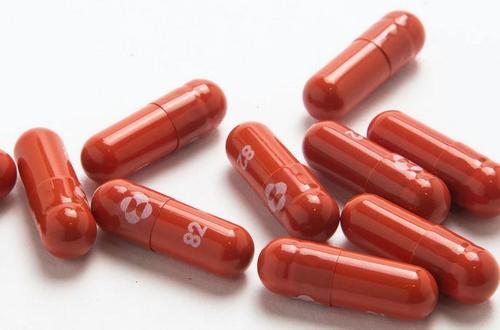
Molnupiravir pill from Merck. Photo: Merck Sharp & Dohme Corp.
The pill, originally developed using US government funds as a possible treatment for Venezuelan equine encephalitis, cut the risk of hospitalization and death in half in a randomized trial of 775 adults with mild/moderate Covid who were considered at high risk for disease due to comorbidities such as obesity, diabetes and heart disease. The trial was stopped early so the company could apply for and emergency use authorization (EUA). The drug did not benefit patients who were already hospitalized with severe disease.
News of the oral 'wonder drug' sent shares of Merck higher last week, as the company says it can deliver 10MM doses by the end of the year.
Clearly, the pill could bring in massive profits to Merck and its partner on the drug, Ridgeback Biotherapeutics - which licensed the drug from Emory University in 2020 and then sold the worldwide rights to the drug to Merck for a sum which has not been disclosed.
Meanwhile, the Defense Threat Reduction Agency, a division of the Department of Defense, funded development of the drug by Emory University to the tune of $10 million between 2013 and 2015, according to nonprofit group Knowledge Ecology International discovered.
Yet, as Quartz points out, only Merck and Ridgeback will profit from the new antiviral - which they say "could be one of the most lucrative drugs ever," bringing in as much as $7 billion by the end of this year alone.
Despite its initial investment, the U.S. government seems to be facing a steep markup in prices. In June, the government signed a $1.2 billion contract with Merck to supply 1.7 million courses of the medication at the $712 price. The transaction is due to take place as soon as molnupiravir receives emergency use authorization from the Food and Drug Administration.
Good government advocates are pointing out that because federal agencies spent at least $29 million on the drug’s development, the government has the obligation to ensure that the medicine is affordable. “The public funded this drug, and therefore the public has some rights, including the rights you have it available under reasonable terms,” said Luis Gil Abinader, senior researcher at Knowledge Ecology International. -The Intercept
Pushing back
Ridgeback co-founder Wendy Holman told CNBCin an interview last week that they asked for, but "never got government funding" for the manufacture of molnupiravir. The company also claimed in a press release touting the study that "since licensed by Ridgeback, all funds used for the development of molnupiravir have been provided by Merck and by Wayne and Wendy Holman of Ridgeback."
Critics, meanwhile, say the $700+ price point is absurd - with health advocates concerned that people some countries will not be able to afford the new drug.
"Offering someone a $700 treatment when they don’t yet feel that ill is going to mean that a lot of people are not going to take it," said King's College Hospital physician Dzintars Gotham, co-author of the report - which suggests that Merck would still reap a 10% profit margin if they priced molnupiravir at $19.99.
"If you can’t afford medicine because it’s 1,000 times more than you can afford, or because it’s 100 times more than you can afford, it doesn’t matter," said Melissa Barber, a doctoral candidate at the Harvard School of Public Health and co-author of the report on molnupiravir, adding "those are both bad."
Barber and Gotham acknowledge that the $17.74 cost of producing a five-day course of the antiviral pills is an estimate but said that the algorithm they used, and have employed to estimate the production costs for hundreds of drugs, tends to result in overestimates in the long run.
Meanwhile, the prices that private companies charge for drugs tend to go up rather than down. “For all these deals that have happened for therapeutics or vaccines, the price has only increased as uncertainty has decreased,” she said. “One price is given and then, for the next sale, the price goes up. The price went up for other drugs and vaccines, so I would be very surprised if this price didn’t go up, too.” -The Intercept
Merck is certainly charging what the market will bear - and then some. If RVX receives emergency use authorization they may be revisiting their pricing model.
Once approved, Apabetalone, priced at $7 would certainly have a competitive advantage and considerable leeway in maintaining that advantage. Brazil continues to have a new daily case load in excess of 200k new patients. I did read that Brazilian health care authorities have been highly criticized for their use of experimental therapies and treatments many of which have been ineffective which may be slowing things down for RVX. However the Phase 2b trial has only 100 patients to test - certainly attainable given the caseload. Hopefully news will be out shortly.
When it comes to the market, that would be left for Aversana to determine the price as they need to add their margins. And the overall price needs to take the $400+ millions it took to develope Apabetalone. What Don has projected in the interviews it will all be forgotten.
I think all of the available answers to questions recently posted here are in that video. I thought it was worth a relisten despite the reminder of so many missed time-lines.
At the 34 min mark Don mentions that a 30-day covid treatment would cost $800. He does not mention Cdn or US in that instance but I think all his figures are in US.
When Don refers to a patient cost of $7/pill (says it is $6.85 in one instance) or $5,000 per year he specifically mentions US$ and it was in the context of the price of the pill for CVD patients later on, and that the initial batch of apabetalone for covid use will cost considerably more. For a 30-day treatment $800 US per patient equals 800 / 30 / 2 = $13.13 US per pill.
His reply to a question about the 'per pill margin' was: "That is an unknown at this stage". This only means that they, at that time, had not signed a mass production contract agreement yet.