

Case IPR2015-00519 Patent 5,839,108
Case IPR2015-00519 Patent 5,839,108
Order14: https://drive.google.com/file/d/0Bx9NLDCScshnaW9PeTRrZDdpcFE/view?usp=sharing
Join the conversation about e.Digital.
ReplyYou’re reading letgojoe1’s reply in this thread.Jump to it
Case IPR2015-00519 Patent 5,839,108
Order14: https://drive.google.com/file/d/0Bx9NLDCScshnaW9PeTRrZDdpcFE/view?usp=sharing
Join the conversation about e.Digital.
Reply
Plank opines:
Plank did not review entire 108 filing, but based on letgo's order.....this ruling is just jurisdictional......the panel did not review the MERITS of the review request yet....
as Plank recalls, EDIG has until 3/31 to file a response to review request and board has 3 more months, end of June to decide whether to accept review....meanwhile Micron squirms...

Case IPR2015-00519 Patent 5,839,108/jurisdicti... only...thanks Plank for your OPINION... it makes better sense now. If I'm reading this right, its only means that e.Digital was only denied the motion to dismiss the petition... nothing more.
“Patent Owner’s Motion To Deny The Petition A Filing Date For Failure To Serve The Patent Owner At The Correspondence Address Of Record And To Dismiss The Petition For Failure To File The Petition Within One Year After Service Of A Complaint For Patent Infringement.”

Yes it still has to go through an approval process, I was a bit premature on a recent post stating the IPR will be approved for review..
It would be nice that the PTO review the MERITS and come to the conclusion that the e.Digital methods are NOVEL in comparison and are patented properly....there by, a formal review not be allowed.
If it could only be that simple.
What other MERITS could there be other than a comparison? Thing is the defendant is challenging 445 for the most part and not 108 directly, other than its claim 1 phrase. Perhaps, some where in that mix the IPR is denied.
doni


Replying to @emit
Just heard that the banks are dealing with a high degree of fraud when signing up customers to use Apple Pay. Maybe the banks and/or Apple could make these transactions more secure with the help of Micro Signet? Maybe as a second level of security?


Replying to @Giants
By Michael Macagnone
Law360, Washington (March 23, 2015, 4:52 PM ET) -- The U.S. Patent and Trademark Office chief administrative judge said Monday the explosion of successful inter partes review challenges is not alone a sign of success and it is too soon to tell if the reforms of the America Invents Act have taken hold.Replying to @sman998
Since I havent had my morning shot I don't quite understand the meaning of SMAN'S post. Does it mean 80% of IPR reviews are granted? Or does it mean when an IPR review is granted then the challenger/infringer wins his challenge on his claim the patent itself is invalid.
If it is the latter does that mean 80% of IPR claims are successful in proving a patent is invalid....That does not sound quite right. 80% of the millions of patents issued by anyone for any reason, when challenged by anyone through an IPR are no good......WOW...I cannot believe that....That's HUGE...
Replying to @sunpoop
As you read Handal comment re IPR , he would like to tackle that issue at conclusionof the trial with Micron . Unfortunately the statistics re IPR proceeding shows thatmajority of cases 70-80 percent the claims in regards to prior art found invalid.At the same time if you appreciate the comment by Handal , he says this case patent#108 IPR is not a complex issues and it only relate to one claim . The way Handal pointing that they are more confident re strength of this lone claim in outcome of IPR final decision.
As you know judge refused Micron stay pending IPR decision , so Handal will forcefully persue all the way to discovery and toward trial date. Who knows may by that time another negotiation re settlement will happens. JMHO

Replying to @sman998
It must be obvious to anyone that uspto does a poor job when researching and approving patents - I guess they are like any other business nowadays - just out for the buck . What do they care if their shoddy work is challenged at some point in the future when that will just net them another hefty fee ?
Replying to @sman998
I still needed clarification......Maybe growing old with EDig has addled my mind but I still am confused as to the meaning of......"UNFORTUNATELY THE STATISTICS RE IPR PROCEEDING SHOWS THATMAJORITY OF CASES 70-80 PERSCENT THE CLAIMS IN REGARDS TO PRIOR ART FOUND INVALID.".......
Does that means when a challenge is made by "anyone" through an IPR that a patent created and owned by "another company" that the challenge is found to be valid 80% of the time and that now the patent owned by this other company is now found to be invalid?
Or does it mean that 80% of the time the IPR challenges are denied?
Or does it mean that 80% of the IPR reviews are granted but when decided upon that these 80% have found the patents to be valid?
Treat me as a 3 year old and use the appropriate language.....
Replying to @sman998
SMAN, I may be a dummy hear but I still cannot get my head around 80% of Patent Claims are invalid......
80% OF ANYTHING stretches the bounds of credulity
Does that mean that anyone challenging the validity of any patent will win that argument 80% of the time, meaning a bona-fide patent holder who invented "anything", who has 100 patents will have 80 of those patents ruled "INVALID".
I have never heard of such a thing and I don't believe a statement like that CAN BE VALID IN ITSELF.
Can you imagine the UTTER CHAOS that would ensue with the millions of bona fide patent holders out there being challenged in an IPR, knowing that 80% of their patents will be ruled INVALID...
That makes ABSOLUTELY NO SENSE TO ME and I haven't heard of this prior to your post.
Is this something BRAND NEW....A new law, new ruling...etc....???
I have the utmost respect for your ability to find these pieces of information and bring them to us on this board. Could you find out EXACTLY who made that statement, when, in what venue and the reason for it???? I need verification to rest my mind because if this is true this is MIND BOGGLING.
What would be the sense of patenting anything under those parimeters, knowing 80% of the time your patent would be found INVALID.......
GEEEZ
Replying to @sunpoop
Intellectual Property Advisory
10.21.2014
BY PATRICK DRISCOLL AND MICHAEL MCNAMARA
September 16, 2014, marked the two year anniversary since certain provisions of the Leahy-Smith America Invents Act went into effect, including post-grant Inter Partes Review (IPR) proceedings before the Patent Trial and Appeal Board (PTAB or Board) and the United States Patent and Trademark Office (USPTO). The Congressional goal of such IPR proceedings was to provide a petitioner the opportunity to challenge the validity of an issued patent in a timely and cost-effective manner so that mistakenly issued patents could be more easily eliminated.1 An early critic, now retired Chief Federal Circuit Judge Randal R. Rader, dubbed the PTAB a “death squad” for patents in an October 2013 speech.2 Since then, many attorneys have echoed such a belief.3 The PTAB has been concerned with the growing view from the bar and the bench that the PTAB is indeed a “death squad,” and consequently, that patents are now less valuable.4 To counteract such a negative perception, the PTAB has been vocal in stating that it does not have an agenda biased against the survival of patent claims and often cites statistics for support.5 The statistical outcomes of IPR proceedings taking place before the PTAB are reported by the USPTO. However, since the data has been reported using various metrics and organizational schemes it can be difficult to understand and easily misinterpreted. What is clear is that the initial filings, specifically a petition and the patent owner’s preliminary response, are of the utmost importance because the PTAB’s decision on the institution of an IPR is very likely determinative of whether or not a patent’s claims will survive.
The USPTO reports that, as of September 25, 2014, a total of 1,821 petitions for IPR have been filed. Of those, the PTAB has reached a decision on whether to institute review for 938 petitions. Of those 938 decisions, 731 IPRs were taken up — about an 80 percent rate of institution. A breakdown of those petitions by decisions and year shows a drop in the percentage of IPRs being instituted; the PTAB instituted reviews for 87 percent of petitions in 2013 and 75 percent of the time in 2014. When compared to all of 2013, 776 additional petitions, or 250 percent more, have been filed thus far in 2014.6 To put that into perspective, the number of IPR requests filed thus far is only 98 fewer than the total number of requests filed for Inter Partes Reexamination from 1999 through 2012.7
Below is a reproduction of the most recent data for claims challenged by petition published by the USPTO for IPRs terminated as of September 4, 2014.8 These statistics use claims as a metric. In other words, what the USPTO is reporting is the disposition of each claim as it goes through the IPR proceedings. At a high level the claim-based data can provide a sense of the trends that are occurring and how likely it may be for an individual claim that is the subject of a petition to eventually be found unpatentable by the Board. However, using claims as a metric obscures data that many would find informative, such as the number of patents petitioned in which some or all claims are cancelled.
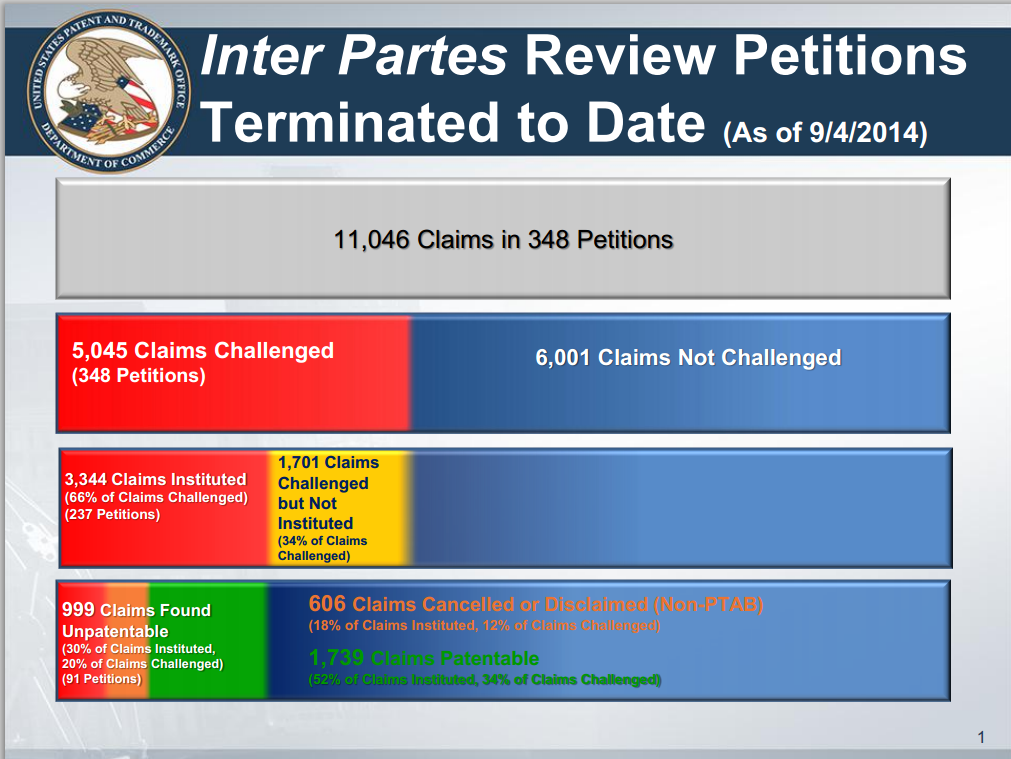
As illustrated in the graphic above, once an IPR has been instituted the USPTO categorizes the outcome of the proceedings on a claim into one of three categories: (i) maintaining patentability (1,739 claims), (ii) cancellation or disclaiming patentability during the proceedings (606 claims), or (iii) finding of unpatentability by the PTAB (999 claims). Based on the currently reported data, once an IPR has been instituted the probability that a claim will not survive is 48 percent, essentially a coin flip.
A very different story is told when one looks at the outcomes of the cases in which the PTAB reached a decision on patentability on a petition basis. The PTAB has reached decisions on patentability in 66 IPR proceedings, of which all claims in six cases — 148 claims in total — were deemed patentable, claims in ten cases met mixed results, i.e., some claims were found patentable and others unpatentable, and all claims in 50 cases were deemed unpatentable. Put another way, when the patentability of claims challenged is determined on a per petition basis, in nine percent of petitions all claims were deemed patentable, in 15 percent of petitions some claims were deemed unpatentable, and in 73 percent of petitions all of the claims were deemed unpatentable. It therefore appears that once the PTAB gets involved, the chances that the challenged claims will be struck down rises precipitously.
While these figures appear to be in stark contrast to those published by the USPTO, the percentage of patents with the patentability of all claims confirmed is in line with the outcomes of the previous validity procedure of Inter Partes Reexamination.9 It remains to be seen whether this is a reasonable comparison. The sharp rise in the number of IPR cases seems to indicate that higher quality patents are being struck down by the PTAB under the new IPR process. Further, it seems that not only are more higher quality patents now being struck down by the PTAB, more are being struck down in their entirety, as the total percentage of IPRs in which all claims were cancelled or disclaimed was 73 percent as compare to a mere 31 percent for Inter Partes Reexaminations.
There is a mere two years’ worth of IPR data, and as more PTAB decisions are published our understanding will continue to deepen. Despite the different statistics being reported, at this point one thing is clear: the petition and patent owner’s initial response are of the upmost importance. Twenty percent of the IPR requests are not instituted, which translates into 207 patents escaping the process by not being taken up. If the PTAB reaches a determination on the patentability of an instituted petition, there is only a nine percent chance that the patent will escape unscathed; a mere six cases have escaped the PTAB so far. Therefore, a petitioner’s best strategy is to ensure that a review is instituted, while a patent owner’s best defense against an IPR is to make certain that one is not instituted in the first place.
Replying to @sman998
Now that we have a growing body of statistics on the Inter Partes Review proceedings created by the America Invents Act, it is interesting to see how the proceedings are being resolved. With the significant attention given to Patent Trial and Appeal Board (PTAB) decisions, it may come as a surprise to learn that a significant majority of IPRs are terminated by settlement.
According to USPTO statistics, as of April 2014, about 1405 Inter Partes Review Petitions had been filed and 167 had been terminated.

Source: http://www.uspto.gov/ip/boards/bpai/ptab_aia_trial_roundtables_2014.jsp
The four most common types of termination are:
Of these, settlement is the most popular type of termination, representing 70% of the terminations. The number of settlement-based terminations before institution vs. after institution are similar, with 53 being settled before and 64 after. This begs the question: Why would a patent owner settle before an IPR even has been instituted?
Initially, it may seem surprising that so many settlements occur before the IPR has progressed to the point of institution. When the petitioner has yet to overcome the threshold burden of institution, it should not have much leverage in settlement negotiations. (The PTAB cannot institute an IPR unless the petitioner shows in its petition that it has a reasonable likelihood of prevailing on invalidating at least one of the challenged claims.) However, there are sound reasons for early settlement.
First, the PTAB has the right to reject settlements and issue a final decision once the proceedings have advanced sufficiently, and it is unclear where or when the PTAB will draw that line. For example, in Blackberry Corporation and Blackberry Limited v. MobileMedia Ideas, LLC (IPR2013-00036, Paper 64), the PTAB determined that the proceedings had advanced enough to warrant a final decision after the petitioner filed a reply to the response and an oral hearing was held. Would the PTAB have accepted the settlement if it had been entered before the oral hearing? Before the substantive papers had been filed?
Second, the statistics to date show that the PTAB has instituted the vast majority of IPR petitions where that decision point has been reached:

Source: http://www.uspto.gov/ip/boards/bpai/ptab_aia_trial_roundtables_2014.jsp
Thus, a patent owner may believe that, at least statistically, the petition is likely to be granted.
Third, a patent owner may be concerned that any PTAB decision on the merits is likely to invalidate at least some of the challenged claims. Statistically speaking, the PTAB has earned its reputation as a “Patent Death Squad.”
Petitioners have a simple financial reason to settle before institution, since institution comes with a $14000 price tag. Moreover, because of the one-year statutory time period within which an instituted IPR must be decided, both parties are likely to incur significant costs early in an IPR proceeding, such that an early settlement may be the only way to avoid incurring those costs.
Both patent owners and petitioners may be opting for early settlement to avoid the uncertainty that surrounds any IPR proceeding. Since IPRs only have been available for two years, every PTAB decision charts new territory, and even procedural questions are unresolved. Moreover, the Federal Circuit and Supreme Court have yet to decide whether the PTAB’s interpretations and applications of the governing statutes are correct. Thus, even following PTAB precedent is an uncertain prospect. It will be interesting to see whether the settlement rate changes once some of these issues are resolved.
Replying to @sman998
Maybe now we'll know, because they'r asking for patent nulification.
invalidation
if the pto rejects it it'll be good sign, if they get it, another nail-biter.
wish Sndk buy us n do it all, but not yet.
If we prevail it'll be BIG.
if we don't it's up to new IP, n hopes it's not dependant on MOS
well, if it's invalided, don't mean we can't still create something with it.
Will you still be here?
e
e
Replying to @emit
Santa Clara University School of Law
Shawn Ambwani
Unified Patents, Inc.
October 20, 2014
University of Chicago Law Review Dialogue, Vol. 81, p. 93, 2014
Abstract:
Replying to @sman998
TO ME THAT 80% OF CLAIMS RULED INVALID IS A BOGUS NUMBER PUT OUT THERE FOR WHATEVER REASON.....
ACCORDING TO EVERYTHING SMAN, IN HIS GREAT SKILL IN BEING A NUMBER ONE FERRET, HAS FOUND AND POSTED, I READ (MY EXAMPLE) THAT IF 1000 PATENTS ARE CHALLENGED WITH AN IPR ONLY 500, OR 50%, OF THOSE CLAIMS ARE EXAMINED.
OF THOSE 500 EXAMINED, 400, OR 80% ARE DEEMED INVALID. TO ME THE MATH SAYS OF ALL THE PATENTS CHALLENGED, 1000, ONLY 400 ARE DEEMED INVALID, OR 40%.
I GUESS IT JUST DEPENDS ON HOW YOU READ THE CONFUSING BLURBS...
Replying to @sunpoop
As i posted earlier ,those two claim construction ruling had broadest
interpretation for the claim one of patent 108.(Also admitted by Micron) JMHO
February 5, 2015
By: Jennifer Coronel
In the first ruling of an appeal of a final decision in an inter partes review (IPR), the Court of Appeals for the Federal Circuit held in In re Cuozzo Speed Technologies, LLC, No. 14-1301 (Fed. Cir., Feb. 4, 2015) that it does not have jurisdiction to review the decision of the U.S. Patent and Trademark Office (PTO) to institute an IPR. In a majority opinion for the Federal Circuit authored by Judge Dyk, the court stated that all review of the decision by the PTO’s Patent Trial and Appeal Board (Board) whether to institute an IPR is precluded, even after a final decision has been issued by the Board. Additionally, the court affirmed that, in an IPR proceeding, patent claims should be construed under the broadest reasonable interpretation standard. Under this standard, the court affirmed the Board’s decision that the patent claims were invalid over the prior art. This decision puts to rest two major challenges to IPRs that patent owners have been advancing, and confirms the advantages of the USPTO as a forum to challenge the validity of U.S. patents.
With respect to its holding that the institution decision is non-appealable, the Federal Circuit cited 35 U.S.C. § 314(d), which states “[t]he determination by the Director whether to institute an inter partes review under this section shall be final and nonappealable.” As further support, it cited § 319 and § 141(c), which permit appeals from final decisions only. Lastly, the court discussed its decision In re Hiniker Co., 150 F.3d 1362 (Fed. Cir., 1998), where it held that even without a provision similar to § 314(d), a mistake in the institution of a reexamination proceeding could not serve as grounds to set aside the final decision. The court found that § 314(d) was written to preclude appellate review of the institution decision. However, the court declined to rule on the issue of whether a petition for mandamus could be used to challenge an institution decision under different facts.
Turning to the facts in In re Cuozzo, Garmin petitioned for an IPR of claims 10, 14, and 17 of Cuozzo’s patent, and the Board instituted an IPR for all three claims. Cuozzo argued that institution was improper for claims 10 and 14 because the Board relied on prior art that Garmin did not identify in its petition with respect to those two claims. Garmin did, however, cite the relevant prior art as grounds for instituting an IPR for claim 17. Cuozzo further argued that § 314(d) only postponed review of the institution decision until after the Board’s final decision. The Federal Circuit disagreed, holding that review of the institution decision was completely precluded.
Next, the Federal Circuit confirmed that the broadest reasonable interpretation standard should be applied to claim construction in an IPR proceeding. The court discussed the PTO’s century-long practice of using this standard and concluded that in enacting the America Invents Act (AIA), Congress impliedly adopted such a standard. Moreover, the AIA granted rulemaking power to the PTO, which it exercised by passing 37 C.F.R. §42.100(b). This regulation states that “[a] claim in an unexpired patent shall be given its broadest reasonable construction….” Additionally, the court stated that the Board’s claim construction would be reviewed under the standards discussed in Teva Pharmaceuticals U.S.A., Inc. v. Sandoz, Inc., 135 S. Ct. 831 (2015), settling the question of whether the Teva decision applies to PTAB proceedings.
In her dissenting opinion, Judge Newman argued that the broadest reasonable interpretation standard should not be applied because inter partes review was intended to act as a substitute for district court litigation of patent validity. She argued that applying a different claim construction standard than in district court defeats the legislative purpose of IPR proceedings. The dissent further stated that the broadest reasonable interpretation standard is appropriate only in examination and reexamination proceedings, where a party may more freely amend its claims.
In re Cuozzo limits the options for directly challenging an IPR institution decision. The decision also confirms the application of the broadest reasonable interpretation standard for claim construction, which may be disadvantageous for a patentee seeking to distinguish a claimed invention from prior art. Barring any change to this decision if there is an en banc review or certiorari to the Supreme Court granted, the PTO will likely continue to be a favorable forum for patent challengers.
If you have any questions or wish to discuss how this decision may impact your company, please contact a member of the Post-Grant Patent Practice group.
Replying to @sunpoop
Put another way, when the patentability of claims challenged is determined on a per petition basis, in nine percent of petitions all claims were deemed patentable, in 15 percent of petitions some claims were deemed unpatentable, and in 73 percent of petitions all of the claims were deemed unpatentable. It therefore appears that once the PTAB( Patent Trial and Appeal board ) gets involved, the chances that the challenged claims will be struck down rises precipitously.
Replying to @sunpoop
SP, funny you should point that out...and you're the only one to point that out.
"If it is the latter does that mean 80% of IPR claims are successful in proving a patent is invalid....That does not sound quite right. 80% of the millions of patents issued by anyone for any reason, when challenged by anyone through an IPR are no good......WOW...I cannot believe that....That's HUGE..."
You better believe it's huge....
I composed a message for BLR last night on that matter, in response to one of his questions. I composed my concern for that large % number issued by a USPTO judge.
Just as I started to post, I killed my material thoughts and said to myself.... what f'n trash this all floats on.
That number signifies to me the USPTO is a worthless pile of sh**. It creates a lot of worthless jobs that approve the patents, where at a later date, after a company has taken its IP to the market...through a higher level of expertise and management, then back peddle to the tune of 80% of invalidity.
80%...????? where's the value in that government sponsored enterprise?
Congress is killing it's constituents....allowing the USPTO to be inept at one level and more stringent at another in playing two sides of the fence.
That statistic aside, I'm not letting it bother me with regard to e.Digitals published claim phrase vs. the challenged prior art claim phrase... as to which carries the broadest limitation. Micron is going to force USPTO to challenge the federal courts claims construction ruling on matters of claim limitation.
e.Digital is not standing alone on the IPR matter.
doni
Doni... I agree with your QUOTE listed below but I have serious doubt that it will be that easy We can only hope for the best.
e.Digital's methods are NOVEL, that I am certain. As a matter of fact, e.Digital's methods are ingenious and way ahead of their time.
If it could only be that simple.
AS I understand the Tax law. If Micron ends up giving EDIG a settlement, they can wirte off the expense against their gross income?
Lawyer expense and whatever funds they give to EDIG. Cost of doing business.
I guess my point is Micron dosn't care about losing money for doing business as much as much as EDIG relies on the settlements they get.
In other works it means a helluva lot more to us.
We are in the corner fighting for crumbs. IMHO.
EDIG has painted this picture, as shareholders we get to observe. And with that we have different opinions of the abstract.

